

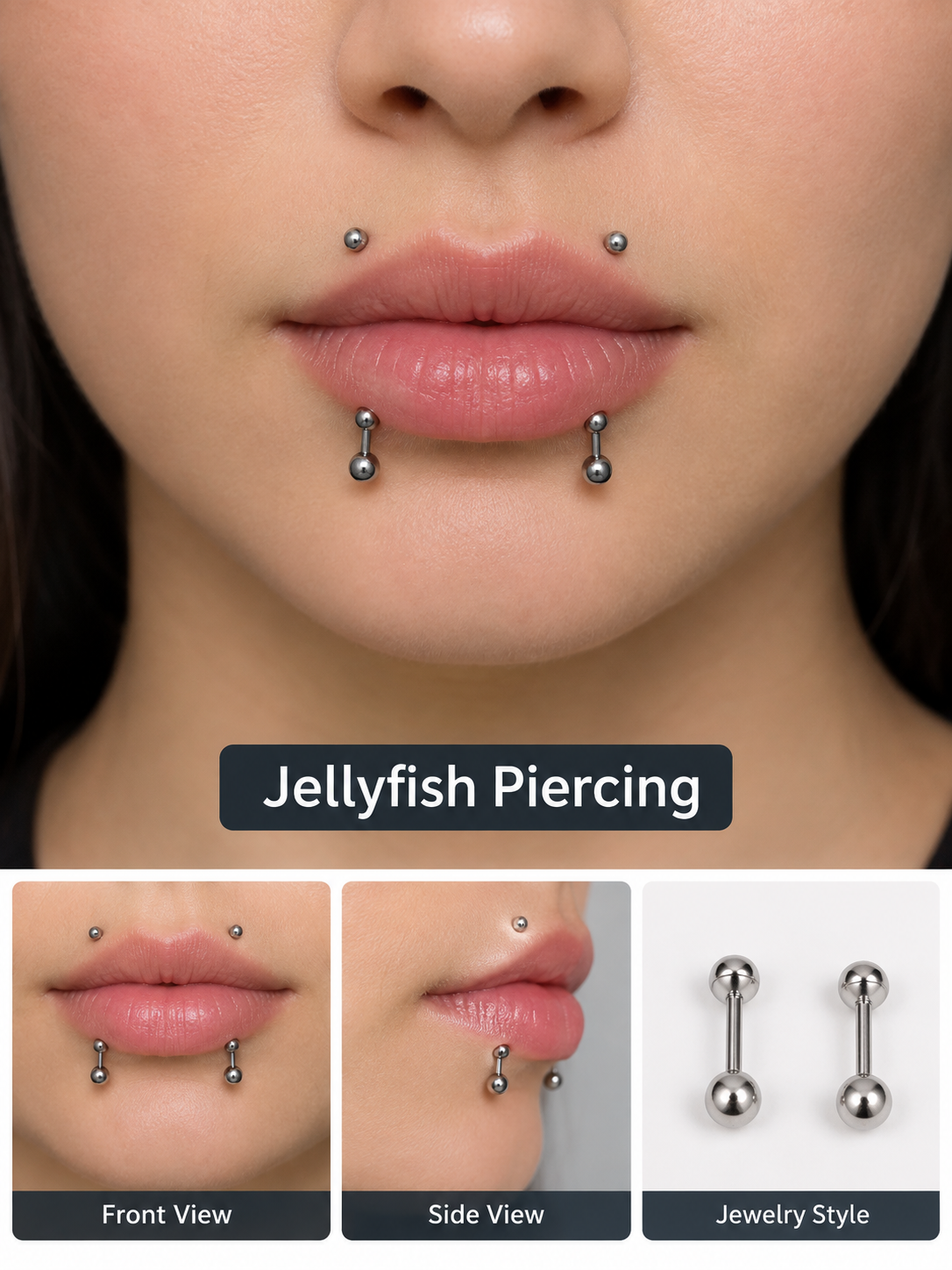

What Is a Jellyfish Piercing?
A jellyfish piercing is a facial/oral-area piercing placed in the central groove between the base of the nose and the upper lip. In current piercing terminology, “jellyfish piercing” is commonly used for the same placement known as a Medusa or philtrum piercing. Piercing studios describe it as a single centered piercing directly below the nasal septum and above the upper lip.

Jellyfish Piercing Placement
The jewelry sits through the philtrum, the vertical groove in the middle of the upper lip. The exact entry and exit points are selected according to your anatomy, tissue thickness, smile movement, and the piercer’s assessment. Correct placement matters because a poorly positioned oral-area piercing can increase the chance of irritation or contact with teeth and gums.
Jellyfish Piercing Pain: How Much Does It Hurt?
Pain varies from person to person. A professional piercing is normally very quick, so the sharp sensation is brief. You may experience pressure, watering eyes, tenderness, or throbbing immediately afterward. Swelling and soreness can be more noticeable during the first few days.
Jellyfish Piercing Healing Time
Healing is individual and can be affected by jewelry quality, placement, aftercare, irritation, smoking, oral habits, and general health. Do not treat a minimum healing estimate as a promise that the piercing is ready for jewelry changes. A qualified piercer should assess the piercing before downsizing or changing jewelry.
Swelling After a Jellyfish Piercing
Some swelling is expected after a fresh piercing. During the initial period, the jewelry may need enough length to accommodate swelling. Once swelling has settled, a professional piercer may recommend downsizing if the post is excessively long. Do not change jewelry early simply because the outside looks healed.
Best Jewelry for a Jellyfish Piercing
For a fresh piercing, implant-grade titanium is a common professional choice because it is lightweight and suitable for many people with metal sensitivities. The appropriate post length and gauge depend on your anatomy and the piercer’s technique. Avoid choosing jewelry solely because it looks attractive; fit and material are more important during healing.
Jellyfish Piercing Jewelry Size
There is no single correct post length for everyone. A piercer should measure or select jewelry based on your tissue thickness and expected swelling. Jewelry that is too short can cause pressure and embedding, while jewelry that is too long can move excessively and catch on teeth or clothing.
Jellyfish Piercing Aftercare
Follow your piercer’s written aftercare instructions. In general, keep hands clean before touching the area, avoid unnecessary movement or twisting, keep cosmetics and harsh products away from the fresh piercing, and maintain good oral hygiene. If the piercing is inside the mouth, follow professional guidance on oral rinsing and avoid aggressive or alcohol-heavy products unless specifically advised.
Can a Jellyfish Piercing Damage Teeth or Gums?
Because the jewelry is near the mouth, tooth and gum contact is an important consideration. Repeated rubbing, biting, or knocking of jewelry against teeth or gum tissue can contribute to irritation or mechanical damage. Jewelry fit and placement therefore matter. If you notice persistent gum recession, tooth sensitivity, cracking, or unusual oral pain, have the piercing assessed by a dental professional and a qualified piercer.
Jellyfish Piercing Bump: Why Does It Happen?
A bump can develop from irritation, pressure, repeated movement, unsuitable jewelry, accidental trauma, or other causes. Do not automatically assume every bump is an infection. Avoid squeezing or popping it. Review the jewelry fit and aftercare routine with a professional piercer; seek medical care if there are signs of a significant infection or rapidly worsening symptoms.
How a Jellyfish Piercing Is Done
A professional piercer first evaluates anatomy and marks the intended placement. After preparing the area with appropriate hygiene procedures, the piercer uses sterile single-use equipment to create the channel and insert suitable jewelry. The procedure itself is brief, but preparation, placement, and correct jewelry selection are critical.
How to Choose a Jellyfish Piercer
Look for a reputable professional who uses sterile, single-use needles, appropriate sterilization practices, high-quality initial jewelry, and clear aftercare instructions. Ask to see healed examples of the piercer’s work and discuss your anatomy and jewelry options before the procedure. A professional should be willing to explain risks rather than promising a completely risk-free piercing.

How Much Does a Jellyfish Piercing Cost?
Cost varies by country, city, studio reputation, jewelry material, and whether premium jewelry is selected. The cheapest option is not necessarily the safest. When comparing prices, check what is included: professional service, initial jewelry, aftercare guidance, and any follow-up or downsizing service.
Jellyfish Piercing vs Other Lip Piercings
Jellyfish vs Medusa
In most current usage, these names refer to the same central upper-lip/philtrum placement.
Jellyfish vs Monroe
A Monroe is placed off-center on one side of the upper lip, while a jellyfish/Medusa is centered.
Jellyfish vs Madonna
Madonna placement is also off-center, on the opposite side from the traditional Monroe position.
Jellyfish vs Snake Bites
Snake bites are a paired lower-lip placement, while jellyfish/Medusa is a single central upper-lip placement.
Jellyfish vs Angel Bites
Angel bites are paired upper-lip piercings; jellyfish/Medusa is a single central piercing.
Pros and Cons of a Jellyfish Piercing
Potential advantages:
· Centered facial placement with a distinctive look
· Works with a range of simple or decorative jewelry styles
· Can become a strong focal point of the face
Potential drawbacks:
· Oral-area jewelry requires careful attention to teeth and gums
· Swelling and tenderness can occur during early healing
· Jewelry fit and placement are important to reduce irritation
· Not every anatomy is suitable for every placement
Frequently Asked Questions
Is a jellyfish piercing the same as a Medusa piercing?
In most current piercing usage, yes. Both commonly describe the central philtrum/upper-lip piercing.
Where is a jellyfish piercing placed?
In the central groove between the base of the nose and the upper lip.
Is a jellyfish piercing painful?
There is a brief sharp sensation and pressure, followed by possible soreness and swelling. Pain varies by person.
How long does a jellyfish piercing take to heal?
Healing varies, so use your piercer’s assessment rather than relying on one fixed number.
Can I change the jewelry myself?
Avoid changing fresh jewelry without professional guidance. A piercer can determine when the channel is ready and whether downsizing is needed.
What is the best metal for a fresh jellyfish piercing?
Implant-grade titanium is a commonly preferred option; your professional piercer can select an appropriate material and size for your anatomy.
Can a jellyfish piercing touch my teeth?
It can. Jewelry that repeatedly contacts teeth or gums may cause mechanical irritation, so placement and fit should be checked.
Leave a Reply