

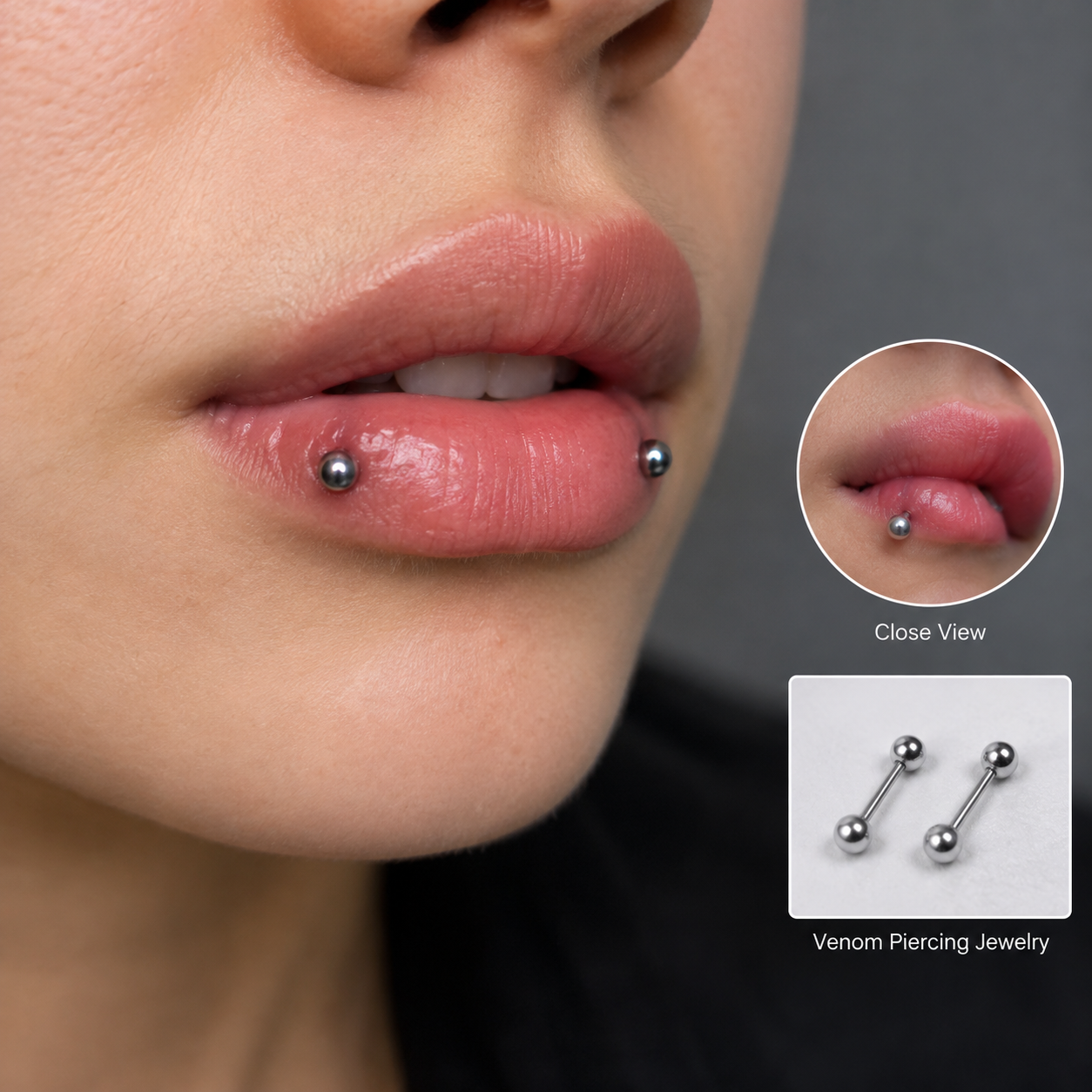

What Is a Venom Piercing?
A venom piercing is a type of tongue piercing that uses two separate piercings placed through the tongue, usually positioned side by side toward the front or middle portion of the tongue. Two pieces of jewelry are worn rather than one central barbell. The name comes from the visual effect, which can resemble the paired fangs of a snake.
Because the tongue contains many blood vessels, nerves, muscles, and glands, this is not a piercing that should be treated as a simple cosmetic procedure. Placement, anatomy, sterile technique, appropriate jewelry, and professional aftercare all matter. A qualified professional piercer should assess your tongue anatomy before deciding whether this piercing is appropriate.
What Does a Venom Piercing Look Like?
A healed venom piercing normally appears as two separate jewelry pieces positioned symmetrically or near-symmetrically on the tongue. The exact position depends on your anatomy and the piercer’s assessment. Some people choose simple titanium barbells, while others prefer decorative ends.

The appearance can change significantly during healing because swelling may make the jewelry look longer or sit differently. Do not judge the final appearance during the first several days or weeks.
Why Is It Called a Venom Piercing?
The term “venom piercing” is mainly a descriptive name based on the two-jewelry appearance. The paired placement can resemble snake fangs, which is why the name is associated with venom and snakes. It does not mean that venom is involved in the procedure.
Venom Piercing vs. Traditional Tongue Piercing
A traditional tongue piercing generally uses one barbell through the center line of the tongue. A venom piercing uses two separate channels.
The two procedures are not interchangeable. A venom piercing requires careful spacing and anatomy assessment because the piercer must create two safe placements rather than one. More jewelry also means more surfaces that can contact teeth and gums, so oral-care habits and jewelry management are especially important.
How Is a Venom Piercing Done?
A professional should begin with an anatomy consultation and explain the planned placement, jewelry, risks, healing expectations, and aftercare. The area should be prepared using appropriate hygiene and sterile equipment.
The piercer marks the intended positions and performs the piercings individually using sterile, single-use equipment. Appropriate initial jewelry is then inserted. Exact technique varies by professional and anatomy, so a reputable piercer should be able to explain the procedure before starting.
Never attempt to pierce your own tongue or have an untrained person perform the procedure.
Does a Venom Piercing Hurt?
Pain is subjective. Many people describe tongue piercings as a quick sharp sensation followed by pressure or soreness. A venom piercing involves two punctures, so discomfort may be greater than with a single tongue piercing.
Swelling and tenderness after the procedure can be more noticeable than the brief piercing itself. Anxiety, individual pain tolerance, anatomy, technique, and aftercare can all affect the experience.
Venom Piercing Swelling
Swelling is common after a tongue piercing and can be significant during the early healing period. The jewelry used initially normally needs enough length to accommodate expected swelling.
Do not replace the initial jewelry with shorter jewelry simply because it looks long during the first few days. Once swelling has reduced, a qualified piercer can assess whether downsizing is appropriate.
If swelling becomes severe or rapidly worsens, especially if you have difficulty breathing or swallowing, seek urgent medical attention.
How Long Does a Venom Piercing Take to Heal?
Tongue piercings can heal relatively quickly compared with some other body piercings, but healing varies between people. A venom piercing should be treated as healing tissue for several weeks even if it starts to feel comfortable earlier.
Do not assume that because pain has disappeared the piercing is completely healed. The inside of a piercing channel can remain vulnerable while the surface looks normal.
Venom Piercing Healing Stages
During the first few days, swelling, tenderness, and sensitivity are common. The tongue may feel awkward while eating or speaking.
During the following weeks, swelling generally decreases and normal movement becomes easier. Jewelry may need professional downsizing when enough swelling has gone down.
Later in healing, the piercing may look and feel normal, but continued gentle oral hygiene and avoidance of unnecessary irritation are still important.
Venom Piercing Aftercare
Follow the specific instructions given by your professional piercer. General care includes maintaining good oral hygiene, keeping hands clean before touching jewelry, avoiding unnecessary movement of the jewelry, and avoiding activities that repeatedly traumatize the piercing.
Rinse your mouth gently as directed after eating and maintain regular tooth brushing. Do not aggressively scrub the piercing or repeatedly spin the jewelry.
If your piercer recommends a particular oral rinse, follow their instructions and avoid overusing products that irritate the mouth.
What Can You Eat After a Venom Piercing?
Soft, cool, and easy-to-eat foods can be more comfortable during the early period. Eat slowly and take smaller bites so the jewelry is less likely to be caught between the teeth.
As swelling improves, most people can gradually return to their normal diet. Pay attention to discomfort rather than forcing foods that irritate the area.
Foods to Avoid During Early Healing
Very spicy, highly acidic, extremely hot, or otherwise irritating foods may be uncomfortable while the tongue is swollen. Hard or crunchy foods can also increase the chance of biting or hitting the jewelry.
The goal is not to follow an unnecessarily restrictive diet for the entire healing period; it is to reduce irritation while the tissue is vulnerable.
Can You Smoke After a Venom Piercing?
Smoking can expose a fresh oral piercing to heat and irritating substances and may interfere with comfortable healing. If you smoke, reducing or avoiding smoking during the early healing period is preferable. Follow your piercer’s aftercare instructions and discuss your smoking habits honestly during the consultation.
Can You Drink Alcohol After a Venom Piercing?
Alcohol can irritate freshly pierced oral tissue, particularly when the area is swollen or sensitive. Avoid alcohol during the early healing period according to your piercer’s instructions. Alcohol-containing mouth products may also be irritating, so use only products recommended for your situation.
Venom Piercing Jewelry
Initial jewelry should be selected for safe healing rather than appearance alone. The length and thickness should match your anatomy and allow for swelling. A qualified piercer should choose the appropriate size.
Jewelry should be smooth, secure, and made from a material appropriate for body piercing. Decorative pieces can be considered later if they are compatible with the piercing and do not create unnecessary contact with teeth or gums.
What Is the Best Jewelry for Venom Piercing?
Implant-grade titanium is commonly considered a suitable choice for many fresh piercings because it is lightweight and can be well tolerated. Other materials may also be appropriate depending on the specific jewelry and individual circumstances.
Avoid cheap, poorly finished, or unknown-metal jewelry. Rough surfaces, damaged threads, or inappropriate sizing can increase irritation.
Venom Piercing Downsizing
The long initial jewelry is there to accommodate swelling. Once swelling has substantially decreased, overly long jewelry can move around more and may strike the teeth or gums. A professional piercer should check the piercing and, when appropriate, replace the initial jewelry with a shorter barbell.
Do not downsize too early or do it yourself during active swelling.
Can Venom Piercing Damage Your Teeth?
Yes, oral piercings can create dental risks. Jewelry can repeatedly contact teeth, particularly when someone clicks, bites, or plays with the jewelry. Repeated impact can contribute to chipped or damaged teeth.
Proper jewelry sizing and avoiding unnecessary movement are important ways to reduce contact. If you notice tooth sensitivity, a chip, or persistent contact, have the jewelry assessed.
Can Venom Piercing Damage Your Gums?
Jewelry can also rub against gum tissue. Repeated friction may contribute to irritation or gum recession in some people. Jewelry position, anatomy, movement, and habits all influence risk.
If jewelry is constantly rubbing a specific area, consult a professional piercer and, where appropriate, a dental professional.
Venom Piercing Risks
Potential complications include swelling, bleeding, infection, prolonged irritation, allergic or sensitivity reactions to unsuitable jewelry, tooth damage, gum irritation, and problems caused by poor placement or inadequate aftercare.
Oral piercings also deserve special attention because the mouth contains many microorganisms and because significant tongue swelling can become an emergency if it interferes with breathing or swallowing.
Signs of a Problem
Seek professional medical advice if you develop symptoms that are severe, worsening, or unusual for normal healing. Concerning signs can include rapidly increasing swelling, severe or persistent pain, significant bleeding, spreading redness, pus-like discharge with worsening symptoms, fever, or difficulty breathing or swallowing.
Do not remove jewelry on your own when you suspect infection without first getting professional medical advice, because the appropriate management depends on the situation.
Venom Piercing and Oral Hygiene
Good oral hygiene is particularly important because the piercing is inside the mouth. Brush your teeth gently and regularly, keep the mouth clean, and follow professional aftercare instructions.
Do not use harsh products excessively. If a mouthwash causes burning or irritation, ask your piercer or dental professional whether you should change products.
Can You Talk Normally With a Venom Piercing?
Speaking may feel awkward immediately after the piercing because swelling changes tongue movement. Most people adapt as swelling decreases.
Avoid deliberately moving the jewelry while speaking. If your work requires frequent speaking, plan the piercing at a time when you can manage the initial discomfort and swelling.
Can You Kiss With a Venom Piercing?
It is sensible to avoid activities that introduce additional bacteria or cause friction while the piercing is fresh. Follow your piercer’s instructions regarding kissing and other oral contact during healing. Once healed, be mindful of jewelry that can contact teeth or soft tissue.
Can You Play With a Venom Piercing?
You should not repeatedly click, bite, pull, or move the jewelry. These habits can irritate the piercing and increase contact with teeth and gums. A piercing should be allowed to remain as stable as possible while it heals.
Venom Piercing vs. Snake Bite Piercing
The names can be confusing. Venom piercing refers to paired tongue piercings, while snake bite piercings are normally a pair of lip piercings placed on opposite sides of the lower lip. They are different procedures with different anatomy, jewelry, and risks.
Venom Piercing vs. Snake Eyes Piercing
Snake eyes is another tongue-piercing style in which jewelry passes horizontally through the front portion of the tongue. Venom piercing uses two separate piercings. These are anatomically different placements, and a professional piercer should explain the specific risks of any tongue piercing before proceeding.
Venom Piercing Pros and Cons
Possible advantages include a distinctive appearance, the ability to wear two coordinated jewelry pieces, and a style that is less common than a central tongue piercing.
Possible disadvantages include two piercing channels, more jewelry in the mouth, swelling during healing, and the potential for dental or gum contact. Whether the style is appropriate depends heavily on anatomy and your willingness to maintain careful aftercare.
Who Is a Good Candidate for a Venom Piercing?
A suitable candidate should have anatomy that can safely accommodate the planned placement and should be able to follow aftercare instructions. A professional piercer should assess the tongue rather than relying only on photographs or online examples.
If you have significant oral health problems, uncontrolled medical issues, a history of problematic wound healing, or other concerns, discuss them with an appropriate healthcare professional before getting pierced.
How to Choose a Venom Piercing Studio
Look for a professional studio that uses sterile, single-use needles and appropriate sterilization practices. The piercer should explain anatomy, jewelry materials, sizing, aftercare, and risks without pressuring you.
Ask to see examples of healed work rather than only fresh piercings. A responsible piercer should be comfortable telling you when your anatomy is not suitable for the requested placement.
Questions to Ask Your Piercer
Useful questions include: What jewelry material will you use? What size will be used initially? When should I return for downsizing? What symptoms are normal? What symptoms require medical attention? How should I clean the piercing? What dental or gum risks should I watch for? What will you do if my anatomy is not suitable?
How Much Does a Venom Piercing Cost?
Prices vary significantly by country, city, studio, piercer experience, jewelry material, and whether follow-up care is included. Very cheap pricing should not be the main reason for choosing a studio.
Ask for the total price, including appropriate initial jewelry and any planned follow-up or downsizing fee, before booking.
Who Should Avoid or Delay a Venom Piercing?
Anyone with a current oral infection, significant uncontrolled swelling, or a situation that makes proper aftercare difficult should consider delaying the procedure and obtaining professional advice. If you are taking medications or have a medical condition that could affect bleeding or healing, discuss this with your healthcare professional before piercing.
Common Venom Piercing Mistakes
Common mistakes include touching the jewelry with unwashed hands, playing with the jewelry, using inappropriate cleaning products, changing jewelry too early, choosing poor-quality jewelry, ignoring dental contact, smoking heavily during early healing, and failing to seek help when symptoms become severe.
Another common mistake is comparing your healing process too closely with photographs online. Individual anatomy and healing vary.
How Do You Sleep With a Venom Piercing?
During the early period, swelling can make sleep uncomfortable. Try to avoid pressure or trauma to the mouth and follow the aftercare instructions provided by your piercer. If swelling is significant, pay attention to any breathing or swallowing problems and seek urgent care if they occur.
Is a Venom Piercing Permanent?
A venom piercing is not necessarily permanent. If jewelry is removed, the channels may shrink or close, although the exact result varies by person and how long the piercing has been established. Small marks or scars can remain.
Can You Remove a Venom Piercing?
Yes, jewelry can usually be removed, but if the piercing is new or there is a suspected infection, do not remove it without professional advice. A piercer can also help you decide how and when to change jewelry safely.
Can a Venom Piercing Reject?
Tongue piercings are not usually described in exactly the same way as surface piercings, but tissue can become irritated, migrate, or develop other problems when placement, jewelry, or aftercare is unsuitable. Unusual movement, persistent irritation, or visible tissue changes should be assessed by a professional.
How Do You Know if a Venom Piercing Is Healing?
Positive signs include gradually decreasing swelling and tenderness, less sensitivity, and normal movement returning. The piercing should become easier to manage over time rather than progressively more painful.
Remember that looking healed from the outside does not guarantee that the entire channel has finished healing.

Final Thoughts
A venom piercing can be a distinctive style, but it is still an oral piercing and deserves careful consideration. The safest approach is to choose an experienced professional, have your anatomy assessed, use appropriate jewelry, follow aftercare instructions, and pay attention to dental and gum contact.
Do not rush the healing process or change jewelry simply because the swelling has improved. If you develop severe swelling, difficulty breathing or swallowing, significant bleeding, or other concerning symptoms, seek appropriate medical care promptly.
Frequently Asked Questions About Venom Piercing
How many piercings are in a venom piercing?
Usually two separate tongue piercings are used.
Is venom piercing very painful?
Pain varies. The procedure is brief, but swelling and tenderness can be noticeable afterward.
How long does venom piercing swelling last?
Swelling is usually most noticeable early in healing and gradually decreases, but the exact duration varies.
Can I eat normally after a venom piercing?
Eating may be awkward at first. Soft, cool foods are often easier, followed by a gradual return to normal foods.
What jewelry is used for venom piercing?
Professional piercers commonly select appropriately sized straight barbells made from suitable body-jewelry materials such as implant-grade titanium.
Can venom piercing damage teeth?
Oral jewelry can contact teeth and contribute to chips or wear, especially when the jewelry is played with or poorly sized.
Can venom piercing cause gum problems?
Repeated rubbing against gum tissue can cause irritation and may contribute to recession in some cases.
Can I smoke after getting a venom piercing?
Smoking can irritate fresh oral tissue. Avoiding or reducing it during early healing is preferable.
When should venom piercing jewelry be downsized?
After swelling has substantially decreased, a professional should assess whether shorter jewelry is appropriate.
What should I do if my tongue becomes extremely swollen?
If swelling interferes with breathing or swallowing, seek urgent medical attention.
Leave a Reply