


What Is a Faux Rook Piercing?
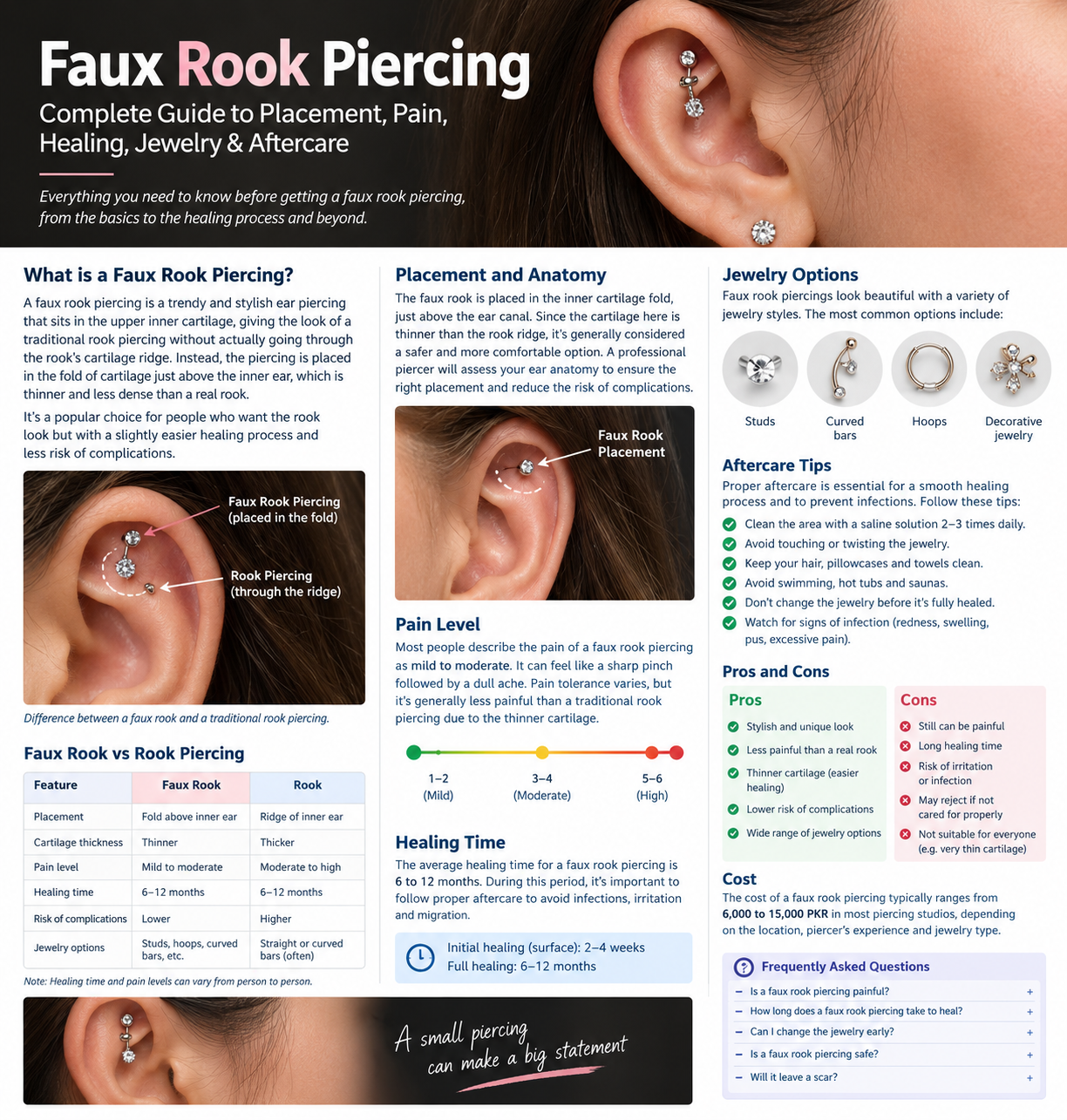
A faux rook piercing is a cartilage piercing positioned to create a visual effect similar to a traditional rook piercing. Instead of passing directly through the traditional rook ridge, the piercing is placed in a nearby fold or area of upper inner ear cartilage that has suitable anatomy.
The exact location is not identical for everyone. A professional piercer should examine the ear before deciding whether the placement is appropriate.
The term "faux" essentially means "false" or "imitation." In this context, the piercing can provide some of the visual character associated with a rook while using a different anatomical location.
This makes the faux rook particularly interesting for people who like the appearance of a rook but do not have suitable anatomy for a traditional rook piercing.

Why Is the Faux Rook Popular?
Several things make this piercing attractive:
However, it should not automatically be considered a "safer" or "easier" alternative to a traditional rook. Cartilage piercings can still take many months to heal and can develop irritation or infection if they are poorly placed or improperly cared for.
Faux Rook Piercing Placement
Placement is one of the most important parts of a faux rook piercing.
A traditional rook is located through the cartilage ridge between the outer and inner portions of the upper ear. A faux rook uses a nearby area rather than piercing through the traditional rook ridge itself.
Because there is no single universal anatomical position for every faux rook, online photographs should not be treated as an exact placement template.
A professional piercer should assess:
Can Everyone Get a Faux Rook?
No.
Ear anatomy is highly individual. Some people have a suitable fold with enough tissue for the piercing, while others may not.
A reputable piercer should inspect your ear before agreeing to the procedure. If the anatomy is unsuitable, forcing the piercing into an inappropriate location can increase the chance of migration, irritation, prolonged healing, or other complications.
Faux Rook vs Traditional Rook Piercing
Feature | Faux Rook | Traditional Rook |
General area | Upper inner ear/fold | Rook ridge |
Exact placement | Anatomy-dependent | More standardized |
Cartilage | Varies by anatomy | Rook ridge cartilage |
Appearance | Rook-inspired | Classic rook look |
Jewelry | Often curved or compact jewelry | Commonly curved barbell |
Healing | Can take several months | Can take several months |
Suitability | Depends on individual anatomy | Depends on individual anatomy |
How Painful Is a Faux Rook Piercing?
Pain is subjective, so there is no single pain score that applies to everyone.
A faux rook passes through cartilage, meaning you should expect more pressure and discomfort than with a standard earlobe piercing.
Many people describe cartilage piercings as a quick sharp sensation followed by pressure, tenderness, or throbbing.
Factors that can influence discomfort include:
The actual piercing procedure is usually very brief. The tenderness afterward can last considerably longer than the initial piercing sensation.
Faux Rook Healing Time
Cartilage piercings generally require patience.
A faux rook may take several months to heal fully, and some piercings can take longer depending on anatomy, jewelry, aftercare, accidental irritation, and individual healing.
It is useful to distinguish between the piercing looking better on the outside and being completely healed internally.
Typical Healing Stages
Early stage: The area may be swollen, tender, warm, or slightly red immediately after piercing.
First few weeks: Tenderness should gradually decrease, although accidental pressure can make the piercing sore again.
Following months: The piercing may look relatively normal while internal tissue continues to heal.
Full healing: The exact timeline varies. Do not assume that a piercing is fully healed simply because it no longer hurts.
Faux Rook Jewelry
Jewelry can dramatically change the appearance of a faux rook.
Common choices include:
Your piercer should select jewelry based on the actual anatomy and piercing placement rather than appearance alone.
What Material Is Best for Faux Rook Jewelry?
For a fresh piercing, jewelry quality matters.
Implant-grade titanium is commonly preferred by professional piercers because it is lightweight, durable, and suitable for many people who experience sensitivity to certain metals.
Other materials may be appropriate depending on the individual and the quality of the jewelry.
When choosing jewelry, look for:
Cheap or poorly manufactured jewelry can create unnecessary irritation.
Faux Rook Aftercare
Good aftercare is essential for a healthy healing process.
What Should You Not Put on a Faux Rook Piercing?
Avoid experimenting with strong substances simply because they are commonly recommended online.
Do not routinely use:
These products can irritate healing tissue.
Sterile saline and appropriate professional aftercare instructions are generally a simpler approach.
Can You Change Faux Rook Jewelry Early?
Changing jewelry too soon can cause unnecessary trauma.
Even when swelling has disappeared, the piercing may still be healing internally.
If the jewelry is too long after initial swelling decreases, a professional piercer may recommend a properly timed downsize. This is different from changing jewelry simply for fashion.
For a healing piercing, have a qualified piercer assess the site before making significant jewelry changes.
Signs of Normal Healing
Some symptoms can occur during normal healing, especially early on.
These may include:
Healing can fluctuate. A piercing may feel fine for several days and become irritated after accidental pressure.
Signs That Need Attention
Some symptoms are more concerning, particularly when they become increasingly severe.
Seek medical advice if you experience symptoms such as:
Do not remove jewelry from a potentially infected piercing without professional medical advice, because closing the opening can sometimes complicate drainage.
Faux Rook Piercing Bump
A bump near a cartilage piercing does not automatically mean infection.
Irritation can occur because of:
The correct response depends on the cause.
If a bump persists or becomes painful, a qualified piercer or healthcare professional can help determine what is happening.
Faux Rook Piercing Pros and Cons
Potential advantages include a unique appearance, rook-inspired style, compatibility with other piercings, and a range of jewelry choices.
Potential drawbacks include cartilage healing, anatomy limitations, irritation from pressure, a healing period that may take months, and the need for careful jewelry selection.
How Much Does a Faux Rook Piercing Cost?
The price varies considerably by country, studio, piercer, jewelry material, and jewelry design.
A professional studio may charge separately for the piercing procedure and jewelry.
In Pakistan, prices can vary from studio to studio, so it is better to compare:
Do not choose a piercing studio based only on the lowest price.
How to Choose a Piercer
The piercer you choose can make a major difference.
Before booking, consider whether the studio:
A good piercer should be willing to say no when your anatomy is not suitable.
Is a Faux Rook Better Than a Rook?
There is no universal answer.
A faux rook and traditional rook are different placements, and the appropriate option depends on your ear anatomy, desired appearance, jewelry preference, and professional assessment.
Someone who cannot safely receive a traditional rook may potentially have another option, while another person may have anatomy that makes the traditional rook more appropriate.
Instead of choosing based solely on photographs, have both options assessed by an experienced piercer.
Can You Get a Faux Rook and Other Ear Piercings Together?
It may be possible to have multiple piercings during the same appointment, but adding several healing cartilage piercings can increase the overall aftercare burden.
The decision should consider:
A professional piercer can help determine whether combining procedures makes sense for your anatomy.
Can You Wear Headphones With a Faux Rook?
This depends on the headphone design and piercing location.
Over-ear headphones may press against certain parts of the ear, while earbuds can sometimes avoid direct pressure but may still contact nearby tissue.
During early healing, avoid anything that repeatedly presses, rubs, or catches the jewelry.
If headphones cause soreness, redness, or swelling, stop using them around the piercing until the irritation settles.
Can You Sleep on a Faux Rook Piercing?
Sleeping directly on a healing cartilage piercing is generally best avoided.
Repeated pressure can increase swelling, cause tenderness, irritate the piercing channel, move the jewelry, and extend the healing process.
A travel pillow with the ear positioned in the opening can sometimes reduce direct pressure.
Faux Rook Piercing and Ear Anatomy
Anatomy is especially important with this type of piercing.
Two ears can look similar but have significant differences in cartilage thickness and folds.
An experienced piercer should examine your ear from different angles before marking the placement.
The jewelry should sit naturally rather than being forced into a position simply because it looks good in an online photograph.
Frequently Asked Questions
Final Thoughts
A faux rook piercing offers a distinctive alternative for people who like the appearance of a rook-style piercing but need a different anatomical placement. Its appeal comes from its subtle position, versatile jewelry options, and ability to add another dimension to an ear-piercing setup.
However, the most important factor is not the trend or photograph you want to copy. It is whether your individual ear anatomy can safely support the piercing.
Choose an experienced professional piercer, use high-quality jewelry, follow appropriate aftercare, avoid unnecessary pressure and manipulation, and give the cartilage enough time to heal.
With the right placement and proper care, a faux rook can become a stylish and personalized part of your ear-piercing collection.
Leave a Reply