

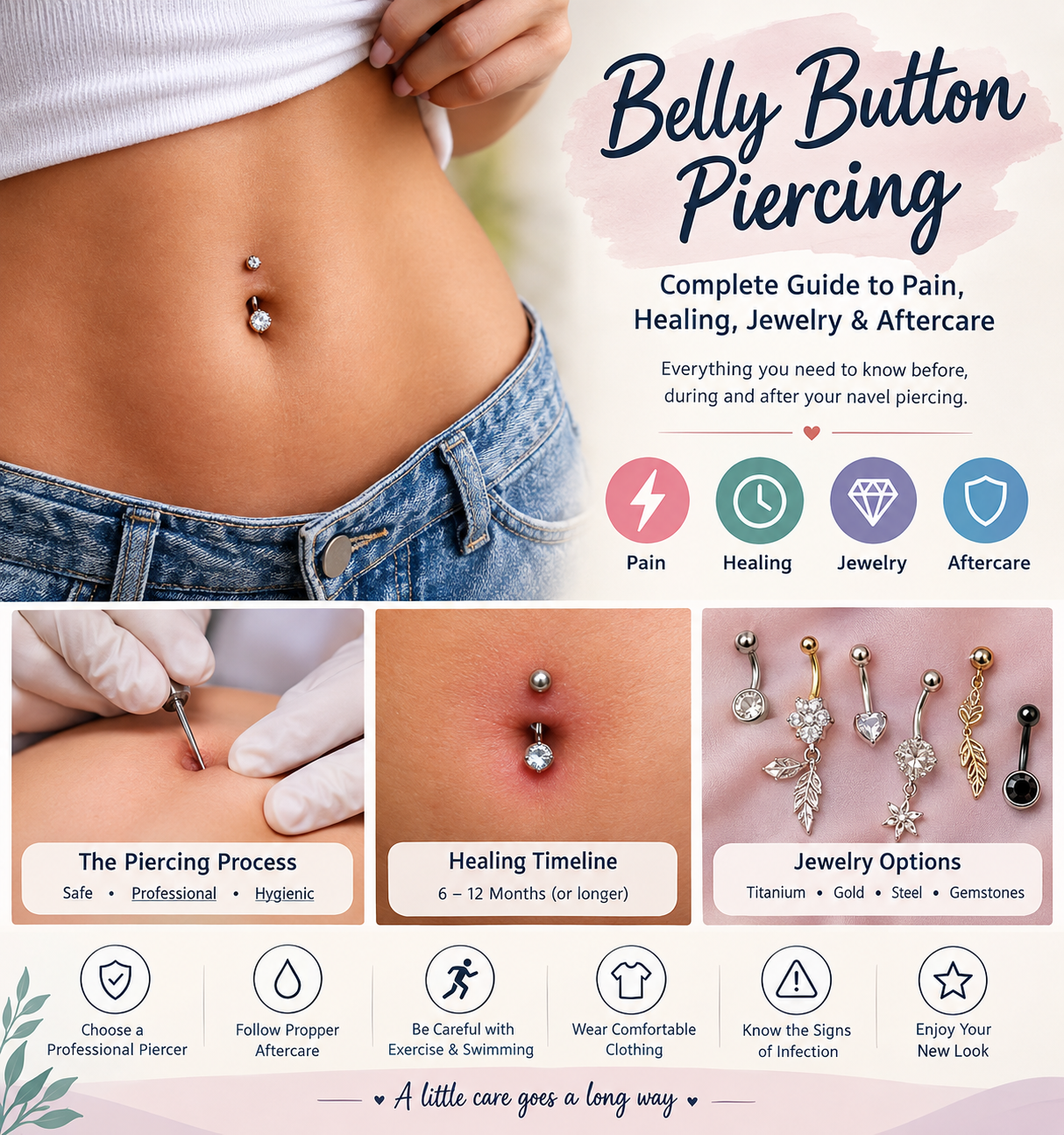

What Is a Belly Button Piercing?
A belly button piercing, also called a navel piercing, is a body piercing placed through the tissue around the navel. Unlike an earlobe piercing, the navel is an area that experiences frequent movement, pressure, and friction from clothing.
The most common style uses a curved barbell. The jewelry passes through the upper rim or fold of the navel, although other placements and jewelry styles are possible depending on individual anatomy.

A professional piercer should examine your navel before piercing it. Not every belly button has the same shape or amount of suitable tissue, so placement should be customized rather than copied from a photograph.
Is a Belly Button Piercing Suitable for Everyone?
Not necessarily.
One of the most important factors is anatomy. A reputable piercer should inspect your navel while you are standing and sitting and determine whether there is enough suitable tissue for stable placement.
How Much Does a Belly Button Piercing Hurt?
Pain is one of the most common concerns among first-time clients.
Most people describe the actual piercing sensation as a brief sharp pinch or pressure followed by mild soreness. Pain levels vary considerably between individuals, so there is no single number that accurately describes the experience for everyone.
The piercing itself usually takes only a few seconds. The more noticeable discomfort may occur afterward as the area becomes tender.
What Does the Pain Feel Like?
You may experience:
Belly Button Piercing Pain Compared With Other Piercings
Pain is subjective, but many people consider a navel piercing manageable compared with some cartilage or surface-style piercings.
Your experience can depend on individual pain tolerance, piercer technique, anatomy, stress or anxiety, jewelry size, and aftercare.
How Long Does a Belly Button Piercing Take to Heal?
A belly button piercing can take around 6 to 12 months or longer to fully heal.
Some people heal sooner, while others need considerably more time. Navel piercings can be slow healers because the area is frequently exposed to movement, friction, pressure, and moisture.
Importantly, a piercing may look healthy on the outside before the internal tissue has completely healed.
Belly Button Piercing Healing Timeline
First Few Days — Mild redness, swelling, tenderness, warmth, and clear or slightly whitish fluid can occur as part of normal healing.
First Few Weeks — The piercing may still feel tender, particularly when clothing rubs against it. Small amounts of dried discharge can form around the jewelry.
First Few Months — The outside may look much better, but the piercing channel can still be healing internally.
Later Healing Stage — As healing progresses, tenderness should decrease and the skin should become more stable.
Belly Button Piercing Aftercare
Good aftercare is one of the most important parts of successful healing. A simple routine is generally better than constantly applying different products.
1. Wash Your Hands First — Always wash your hands thoroughly before touching the piercing.
2. Clean the Piercing Gently — Use an appropriate sterile saline wound-wash product when recommended by your piercer.
3. Do Not Twist the Jewelry — You do not need to rotate or twist the barbell to keep the piercing open.
4. Keep the Area Dry — After showering, gently dry around the piercing.
5. Minimize Friction — Loose, breathable clothing can be more comfortable during healing.
What Should You NOT Put on a Belly Button Piercing?
Many household products can irritate healing tissue. Avoid rubbing alcohol, hydrogen peroxide, strong antiseptics without professional advice, perfume, body sprays, heavy creams, random antibiotic ointments, essential oils, and harsh soaps.
Normal Healing vs Infection
During healing, mild redness, mild swelling, tenderness, clear fluid, pale or whitish dried discharge, and temporary sensitivity can occur.
Seek medical advice if you develop increasing redness spreading away from the piercing, significant swelling, severe or worsening pain, thick pus-like discharge, increasing warmth, fever or chills, red streaking, or feeling generally unwell.
Belly Button Piercing Bump
A small bump around a navel piercing is not automatically an infection. Irritation can develop because of friction, tight clothing, excessive touching, sleeping pressure, jewelry movement, poor-quality jewelry, over-cleaning, strong cleaning products, or accidental pulling.
If the bump continues to enlarge, becomes painful, produces concerning discharge, or is accompanied by spreading redness or systemic symptoms, seek professional medical advice.
Belly Button Piercing Rejection and Migration
Migration happens when a piercing gradually moves from its original position. Rejection occurs when the body pushes the jewelry toward the surface and the tissue between the openings becomes progressively thinner.
Possible warning signs include increasingly visible jewelry, thinning skin between the openings, the piercing appearing closer to the surface, persistent irritation, or a stretched or unusual piercing channel.
Can Belly Button Piercing Leave a Scar?
Any piercing can potentially leave a mark or scar. The final appearance depends on individual healing, jewelry, placement, trauma, infection, rejection, genetics, and how long the jewelry was worn.
What Jewelry Is Best for a Belly Button Piercing?
Jewelry quality matters because the piercing remains in contact with healing tissue for many months. A curved barbell is one of the most common choices for a navel piercing.
Implant-grade titanium is widely used for body jewelry because it is lightweight and generally well tolerated. Gold jewelry can also be suitable when it is appropriate for body piercing and made to a suitable standard.
Some people tolerate high-quality steel well, but steel is not universally appropriate for everyone because certain alloys can contain nickel.
What Size Jewelry Is Used for a Belly Button Piercing?
There is no single universal size that works for every person. A professional piercer chooses the length and gauge according to your anatomy, expected swelling, jewelry style, placement, and healing requirements.
When Can You Change a Belly Button Piercing?
Do not change a fresh navel piercing simply because you want different jewelry. Because healing can take 6–12 months or longer, changing jewelry too early can damage the developing piercing channel.
A professional piercer may recommend a downsize once initial swelling has reduced.
Can Belly Button Piercing Affect Exercise, Swimming, or Showering?
You can usually remain physically active, but protect the healing piercing. Avoid activities that repeatedly pull, compress, or rub the area.
During early healing, it is generally sensible to avoid pools, hot tubs, lakes, rivers, and similar bodies of water when possible.
Normal showering is generally compatible with piercing aftercare. Avoid aggressively scrubbing the jewelry and gently dry the area afterward.
Sleeping With a Belly Button Piercing
Avoid direct pressure on the navel. If you normally sleep on your stomach, you may need to change your position temporarily during the early healing period.
Clothing and Belly Button Piercing
Clothing is one of the biggest sources of irritation during navel piercing healing. Tight waistbands can continuously press against the jewelry. Choose clothing that minimizes friction and compression.
Belly Button Piercing and Pregnancy
If you already have a healed navel piercing, pregnancy may stretch the surrounding skin and change how the piercing looks. If you are pregnant or planning pregnancy, speak with a qualified healthcare professional and an experienced piercer about appropriate jewelry.
Getting a new belly button piercing during pregnancy should be discussed with your healthcare provider rather than treated as a routine piercing appointment.
Belly Button Piercing for Different Body Types
A navel piercing is not limited to one body type. People have naturally different navels, abdominal shapes, skin folds, body sizes, and skin elasticity.
The correct placement depends on anatomy, not body weight or a particular appearance.
How to Choose a Professional Piercer
Look for a professional who uses sterile, single-use needles; uses appropriate sterilization equipment; performs an anatomy assessment; explains the procedure clearly; uses high-quality jewelry; provides written aftercare instructions; maintains a clean studio; and is willing to answer questions.
What Happens During a Belly Button Piercing?
1. Consultation — The piercer examines your anatomy and discusses placement and jewelry.
2. Preparation — The area is cleaned and prepared using appropriate hygiene procedures.
3. Marking — The piercer marks the intended entry and exit points, and you should have an opportunity to check the proposed placement.
4. Piercing — A sterile single-use needle is used to create the piercing channel and the jewelry is inserted.
5. Aftercare Instructions — The piercer should explain how to care for the piercing and what signs require attention.
How Much Does a Belly Button Piercing Cost?
The price varies significantly depending on location, studio standards, piercer experience, and jewelry. When comparing prices, consider the complete package: piercing service, jewelry quality, sterilization standards, piercer experience, and aftercare support.
Belly Button Piercing Jewelry Ideas
Once the piercing has fully healed, popular styles include a simple curved barbell, gemstone belly ring, dangle jewelry, gold belly ring, and minimalist jewelry.
Dangling designs should generally be reserved for a fully healed piercing because they can move and catch more easily.
When Is a Belly Button Piercing Fully Healed?
A fully healed piercing should generally be comfortable during normal movement, free from persistent swelling and ongoing tenderness, stable when assessed by a professional, and able to tolerate appropriate jewelry changes without irritation.
Common Belly Button Piercing Mistakes
Common mistakes include changing jewelry too early, touching the piercing constantly, twisting the jewelry, using harsh chemicals, wearing tight clothing, picking dried discharge, and ignoring signs of rejection.
Belly Button Piercing Pros and Considerations
Advantages: attractive and customizable; a wide variety of jewelry styles; can be discreet under clothing; can complement different fashion styles.
Things to consider: healing can take many months; clothing can cause friction; exercise may require extra care; swimming may need to be avoided during early healing; jewelry can catch on clothing; rejection and migration are possible; individual anatomy affects suitability.
Belly Button Piercing Checklist Before Your Appointment
Choose a reputable professional.
Ask about sterilization procedures.
Ask what jewelry material will be used.
Have your anatomy assessed.
Avoid arriving with irritated or damaged skin around the navel.
Wear comfortable clothing.
Eat normally before the appointment if appropriate for you.
Follow the piercer's aftercare instructions.
Plan for a long healing period.
Avoid choosing jewelry based only on appearance.
Belly Button Piercing FAQs
Does a belly button piercing hurt? — It usually causes a brief pinch or pressure, followed by tenderness. Individual pain levels vary.
How long does a belly button piercing take to heal? — A navel piercing commonly takes around 6–12 months or longer to fully heal.
Can I change my belly ring after one month? — Usually, you should not change jewelry simply for cosmetic reasons after only one month. A professional may recommend a downsize earlier if appropriate.
Can I sleep on my stomach after getting a belly piercing? — Direct pressure can irritate a healing piercing, so avoiding pressure on the area is preferable.
Can I swim after getting a belly button piercing? — It is best to avoid swimming during the early healing period when possible.
What jewelry is best for a new belly piercing? — High-quality implant-grade titanium is commonly considered a suitable option for fresh body piercings.
Can a belly button piercing reject? — Yes. Migration and rejection can occur.
Is a belly button piercing permanent? — No. You can remove the jewelry, but the piercing may leave a small scar or mark.
Can I get a belly piercing if I have a scar? — It depends on the scar and available tissue; a professional piercer should assess it.
Why is my belly button piercing still sore? — Navel piercings can heal slowly. Persistent or worsening symptoms should be assessed.
Is clear discharge from a healing belly piercing normal? — Small amounts of clear or pale fluid can occur during normal healing; concerning symptoms require attention.
Can I exercise after getting a belly piercing? — Generally yes, but avoid activities that repeatedly pull, compress, or rub the piercing.
Can I wear high-waisted jeans after a belly piercing? — Tight high-waisted clothing can put pressure on the piercing during healing.
What should I do if my belly piercing gets caught on clothing? — Do not pull forcefully. Carefully release the clothing and seek advice if there is significant injury.
Is a belly button piercing suitable for every navel? — No. Individual anatomy determines whether a traditional navel piercing is appropriate.
Final Thoughts
A belly button piercing can be a stylish and highly customizable form of body jewelry, but its success depends on more than the piercing appointment itself.
Choosing an experienced piercer, selecting appropriate jewelry, following a gentle aftercare routine, reducing friction, and allowing enough time for complete healing can all help create better conditions for recovery.
The most important thing is patience. A navel piercing can look attractive soon after the procedure while the deeper tissue is still healing. Avoid unnecessary jewelry changes, excessive touching, harsh cleaning products, and constant pressure from clothing.
If you notice persistent or worsening symptoms such as spreading redness, severe pain, significant swelling, pus-like discharge, fever, or progressive migration of the jewelry, seek professional medical or piercing advice rather than trying to treat the problem yourself.
Leave a Reply