


Introduction
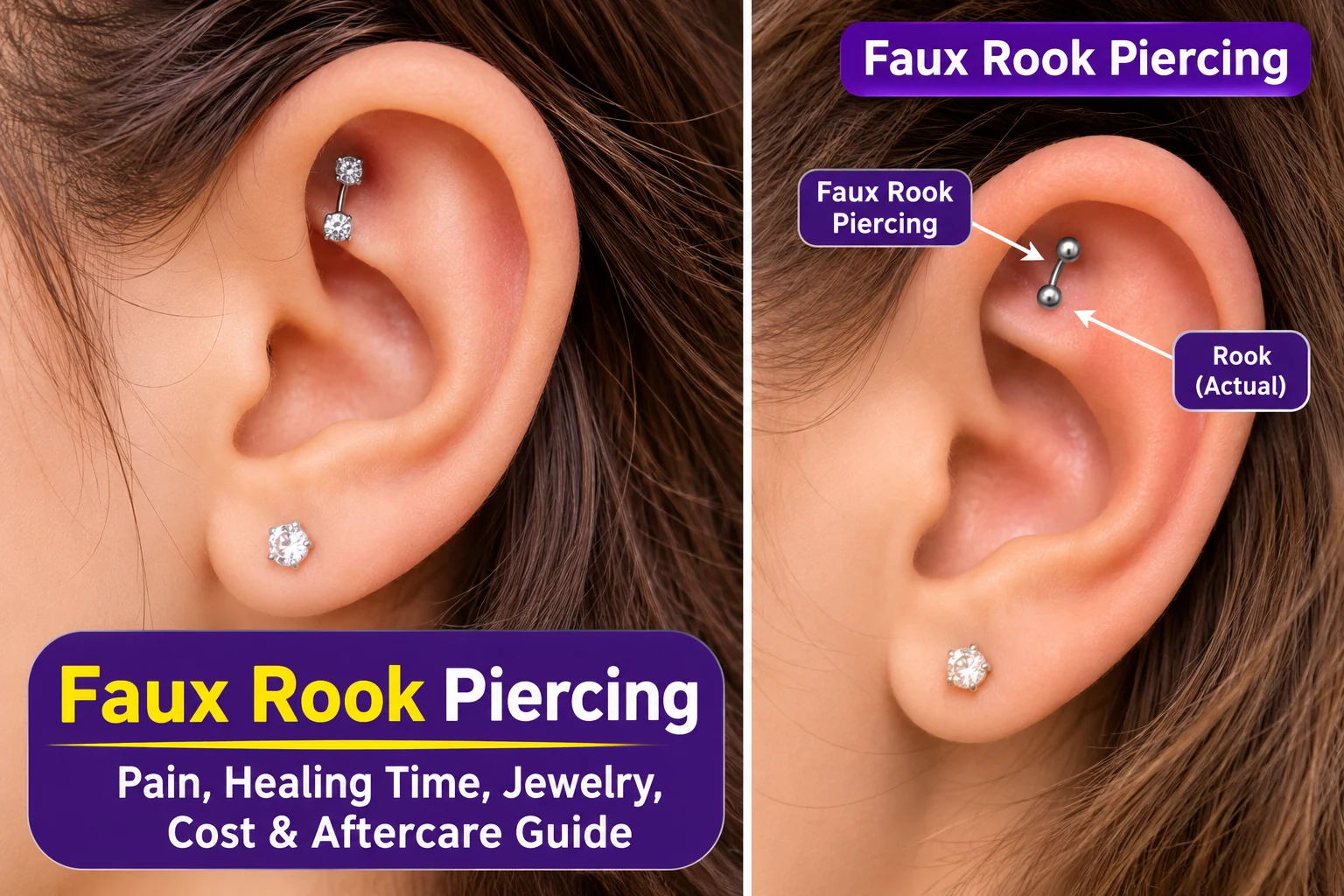
A faux rook piercing is a cartilage-piercing look designed to create an appearance similar to a traditional rook piercing without necessarily passing through the same fold of cartilage. It is often chosen by people who like the tucked-in, curved-jewelry look of a rook but whose ear anatomy may not suit a conventional rook placement. The exact placement can vary from one ear and piercer to another, so “faux rook” is best understood as a style description rather than one universally standardized piercing location.

Before booking, ask an experienced professional to assess your ear in person and explain exactly where the needle would enter and exit. A photo or social-media name alone is not enough to determine whether a particular placement is suitable. This guide covers the general idea, pain, healing, jewelry, price factors, aftercare, possible problems, and questions to ask before getting pierced.
What Is a Faux Rook Piercing?
A traditional rook piercing passes through the antihelix fold inside the upper ear. A faux rook aims to create a similar visual effect using a different placement or piercing arrangement, depending on the person's anatomy and the piercer's approach. In some examples, a small curved barbell or a carefully positioned pair of pieces creates the impression of jewelry sitting in the inner cartilage fold.
There is no single placement that every studio uses under the name faux rook. Some studios may use the term for a nearby cartilage piercing, while others may describe a custom arrangement. Confirm the actual piercing site, the number of piercings involved, and the jewelry plan during a consultation.
A professional should examine the ear from the front and side, check the thickness and shape of the cartilage, and explain whether the proposed placement can be performed safely. Never try to copy a placement from a photograph without an anatomy assessment.
Faux Rook vs. Traditional Rook Piercing
The main difference is the location and technique. A traditional rook goes through the specific ridge of cartilage known as the antihelix fold. A faux rook is intended to imitate the appearance but may use a nearby or alternative placement. Because “faux rook” is not a single standardized anatomical term, comparisons should be made using the piercer's exact proposed placement rather than the label alone.
A traditional rook may not be suitable for every ear because the fold can be too shallow, narrow, or shaped differently. An alternative placement may offer a similar aesthetic for some people, but it is not automatically easier, safer, or faster to heal. Any cartilage piercing requires careful placement, appropriate jewelry, and consistent aftercare.
Ask the studio to show you the proposed entry and exit points on your own ear with a skin-safe marker before the procedure. Make sure you understand whether the plan involves one piercing or more than one.
How Much Does a Faux Rook Piercing Hurt?
Pain is personal and cannot be predicted precisely. Cartilage is firm, so a faux rook-style placement may feel sharper or more intense than a standard earlobe piercing. Many people describe cartilage piercing as a quick pinch followed by pressure, warmth, or tenderness. The procedure itself is usually brief, but the ear can remain sensitive afterward.
Your experience may depend on the exact location, cartilage thickness, technique, stress level, and individual pain sensitivity. A reputable piercer should explain what to expect and should never pressure you to continue if you feel uncomfortable. Eat beforehand, stay hydrated, and avoid alcohol or recreational drugs before the appointment.
Do not use numbing products unless your piercer and an appropriate healthcare professional have confirmed that the product is suitable. Some products can change the skin or complicate the procedure. Never take medication solely to get through a piercing without checking whether it is safe for you.
Faux Rook Piercing Healing Time
Cartilage piercings generally take much longer to heal than earlobe piercings. A realistic planning range for many ear-cartilage piercings is around six to twelve months, and some take longer. The exact timeline depends on the placement, individual healing, jewelry fit, pressure, and whether the piercing experiences irritation or infection.
A piercing can look calm on the outside before the channel is fully healed internally. Less redness or tenderness does not automatically mean it is ready for a jewelry change. Keep following professional aftercare guidance and have your piercer assess the piercing before changing jewelry or stopping routine care.
Healing is not always linear. A piercing may feel comfortable for several weeks and then become irritated after sleeping on it, catching it with clothing, using unsuitable headphones, or changing jewelry too early. If symptoms worsen rather than gradually settle, seek advice from a qualified piercer or healthcare professional as appropriate.
Best Jewelry for a Faux Rook Piercing
Jewelry must match the actual placement and your anatomy. Depending on the piercing design, a professional may recommend a curved barbell, a suitable flat-back labret, or another piece specifically designed for that location. Do not assume that a curved barbell is correct for every faux rook-style placement.
For initial jewelry, implant-grade titanium is commonly recommended because it is suitable for many people with sensitive skin and can be supplied in verified grades. Nickel-free solid 14k or 18k gold may be an option when it is appropriate for the placement and manufactured to piercing-quality standards. Niobium can also be suitable in some circumstances. Ask the piercer to identify the material rather than relying on vague descriptions such as “surgical steel” or “hypoallergenic.”
The jewelry should have enough room for expected swelling without being excessively long or loose. Jewelry that is too tight can put pressure on the tissue; jewelry that is too long can move, snag, and irritate the channel. A professional piercer should select the initial size and advise whether a later downsize is needed after swelling settles.
Avoid plated, coated, mystery-metal, or low-quality fashion jewelry in a fresh piercing. Decorative ends should be smooth, secure, and appropriate for the location. Do not change or remove jewelry yourself during early healing unless a qualified professional or clinician tells you to do so.
Faux Rook Piercing Cost
The cost varies by country, city, studio reputation, piercer experience, jewelry material, and whether the design involves one piercing or multiple placements. A studio may quote the service fee separately from the jewelry, while another may provide a combined price. Because there is no universal faux rook procedure, ask for an itemized quote after the piercer has assessed your ear.
Do not choose a studio simply because it offers the lowest price. A safe piercing should be performed with sterile, single-use needles, appropriate sterilization procedures for reusable equipment, clean work practices, and jewelry suitable for a fresh piercing. The studio should be willing to explain its hygiene process and answer questions without becoming defensive.
Before paying, confirm what the quoted price includes: consultation, piercing service, initial jewelry, follow-up check, and any later jewelry downsizing. Also ask about the studio's policy if the anatomy assessment shows that the requested look is not suitable.
Faux Rook Piercing Aftercare
Good aftercare reduces avoidable irritation, although it cannot guarantee that complications will never occur. Follow the written instructions provided by your professional piercer and keep the routine simple.
Avoid applying alcohol, hydrogen peroxide, harsh antiseptics, tea tree oil, or thick ointments unless a clinician specifically recommends a product for a diagnosed problem. These can irritate healing tissue. Over-cleaning can also cause dryness and irritation, so follow a consistent, gentle routine rather than repeatedly cleaning throughout the day.
Sleeping, Headphones, and Everyday Activities
Pressure is a common source of irritation for ear-cartilage piercings. Try to sleep on the opposite side and avoid pressing the piercing into a pillow. A travel pillow with an opening can sometimes help, provided the jewelry does not catch on the fabric and the pillow is kept clean.
Over-ear headphones, helmets, hats, scarves, and tight headwear may rub against the area. Check the fit before using them and avoid any item that presses directly on the jewelry. Earbuds may be unsuitable if they contact the piercing or cause the ear to move. Be careful when brushing hair, changing clothes, and using towels, as snagging can cause swelling and tenderness.
If your work or hobbies involve protective headgear, discuss this before booking. The piercer can help assess whether the placement is practical for your daily routine.
Possible Problems and When to Get Help
Some mild tenderness, localized swelling, and a small amount of clear or pale fluid that dries into a light crust can occur during early healing. Symptoms should generally become less intense over time. Persistent or worsening pain, increasing heat, spreading redness, marked swelling, or thick discharge can indicate a problem that needs assessment.
Cartilage infections deserve particular attention because they can become serious and may damage ear tissue. Seek prompt medical advice if you develop worsening pain, spreading redness, significant swelling, fever, or pus. If you suspect an infection, do not remove the jewelry on your own unless a healthcare professional tells you to; removal may complicate drainage or assessment in some cases. A clinician should guide treatment.
A bump is not automatically a keloid or an infection. Irritation bumps can be associated with pressure, movement, unsuitable jewelry, or aftercare products. Do not squeeze, cut, or treat a bump with home remedies. Have it assessed by a reputable piercer, and seek medical advice if there are signs of infection or the problem is persistent.
Who May Not Be a Good Candidate?
Not every ear can support every cartilage placement. The available cartilage fold, tissue thickness, existing piercings, scars, and the direction in which jewelry would sit all matter. A professional may advise against the requested look if the anatomy does not provide enough tissue or if the jewelry would sit under constant pressure.
People with a history of problematic wound healing, certain skin conditions, immune-system concerns, bleeding disorders, or medications that affect healing should discuss piercing with a healthcare professional before proceeding. This is not a complete medical screening list, and individual advice matters. If you have an active skin infection near the ear or are unwell, ask a healthcare professional whether it is appropriate to postpone.
A responsible piercer should be comfortable declining a placement that is not suitable. A refusal based on anatomy or safety is a sign of professional judgment, not poor service.
How to Choose a Professional Piercer
Look for a studio that uses sterile, single-use piercing needles and can explain its sterilization and hygiene procedures. The piercer should assess your anatomy in person, discuss placement and jewelry options, explain possible risks, and provide clear written aftercare instructions. They should also be willing to answer questions about their training and experience with cartilage piercings.
Review healed examples of the piercer's work rather than judging only fresh-piercing photographs. Fresh swelling can change how jewelry appears, so healed examples provide a better sense of long-term placement. Check that the jewelry is appropriate for initial wear and that the studio does not use a piercing gun for cartilage.
Avoid a provider who guarantees a painless procedure, promises a fixed healing date, recommends rotating the jewelry, or dismisses concerns about swelling and infection. Good communication and safe technique matter more than a trend or a low price.

Frequently Asked Questions
Is a faux rook the same as a rook piercing? No. A traditional rook passes through the antihelix fold. “Faux rook” describes a look that imitates it using a different or customized placement. Confirm the exact location with your piercer.
How long does a faux rook take to heal? Ear cartilage often needs around six to twelve months or longer. Healing varies, and the piercing should be assessed before jewelry changes.
Can I sleep on a faux rook piercing? Avoid direct pressure while it heals. Sleeping on it can cause irritation, swelling, and bumps.
What jewelry is best? It depends on the actual placement and anatomy. Implant-grade titanium is a commonly recommended initial option; your piercer should select the correct style and size.
Can I change the jewelry early? Do not change it during early healing unless your piercer or a healthcare professional advises you to. A professional can assess whether downsizing is needed.
Does a faux rook hurt more than a lobe piercing? Cartilage is firmer than earlobe tissue, so the sensation may be more intense. Pain differs from person to person.
Can everyone get a faux rook? No. The suitability depends on individual ear anatomy and the exact technique. An in-person assessment is essential.
What should I do if it becomes hot, very swollen, or increasingly painful? Seek prompt medical advice, particularly if redness spreads, pus appears, or you develop a fever. Do not self-diagnose or rely on home remedies.
Conclusion
A faux rook piercing can create a distinctive inner-ear look for people who like the appearance of a traditional rook but may need an alternative placement. The term can describe different approaches, so the most important step is to understand the exact piercing plan and confirm that it suits your ear anatomy.
Choose an experienced professional, use appropriate initial jewelry, avoid pressure and unnecessary handling, and follow gentle aftercare throughout the long cartilage-healing period. Be patient, and get medical help if symptoms suggest infection. A well-planned piercing should prioritize your anatomy and long-term ear health over copying a photograph or following a trend.
Leave a Reply