


Introduction
Ear piercings are a popular way to express personal style. While lobe and helix piercings remain common, cartilage piercings offer more distinctive options. One unusual style is the anti-tragus orbital piercing, which combines placement around the anti-tragus with the circular appearance of orbital jewelry.
An orbital arrangement generally uses one continuous ring that passes through two separate piercing openings. Because the anti-tragus is a relatively small area of cartilage, this style requires careful anatomical assessment, suitable jewelry, and consistent aftercare. Not every ear has enough space or the right shape to support it.

This guide explains the placement, expected discomfort, healing time, jewelry choices, cost considerations, risks, and aftercare for an anti-tragus orbital piercing.
What Is an Anti-Tragus Orbital Piercing?
The anti-tragus is the small raised cartilage area opposite the tragus, just above the earlobe. An anti-tragus piercing is made in this region. An orbital piercing, by contrast, describes a jewelry arrangement in which one circular piece passes through two piercing openings.
An anti-tragus orbital arrangement therefore combines the two ideas: two appropriately positioned openings around the anti-tragus area connected by a single ring. The exact configuration depends on the person's ear anatomy and the piercer's assessment.
Terminology and availability can vary between studios. Ask the piercer to explain the proposed placement and show how the jewelry will sit before proceeding.
Where Is It Located?
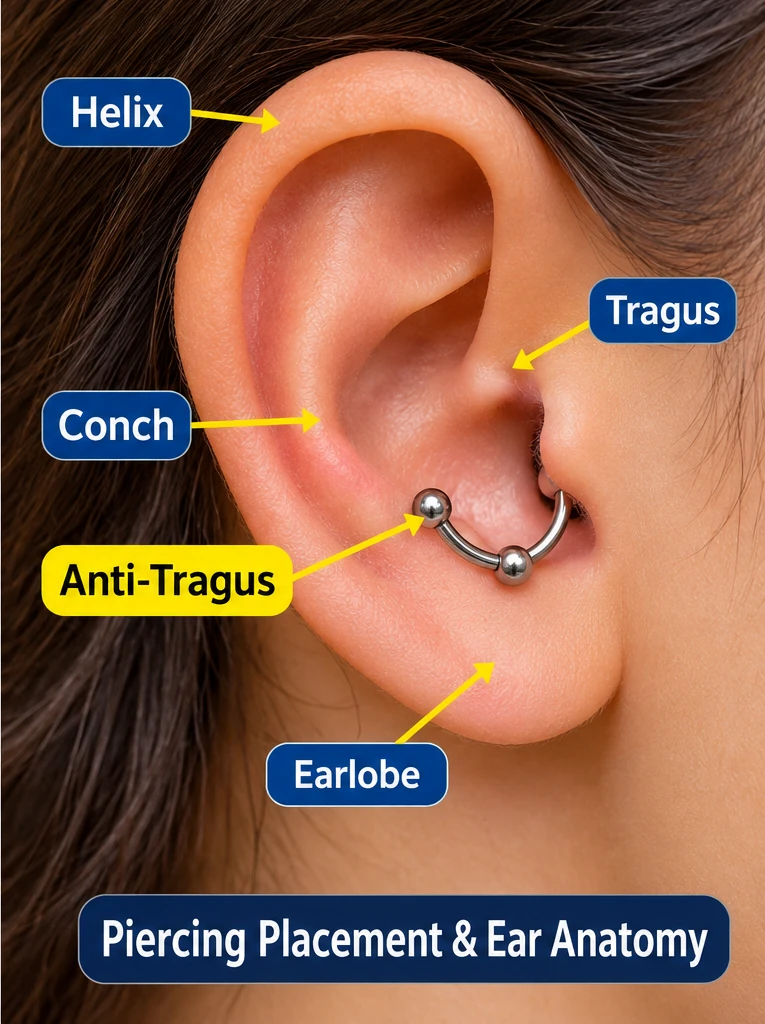
The anti-tragus sits opposite the tragus, above the earlobe and below the outer rim of the ear. Nearby structures include:
· Tragus: the small cartilage flap in front of the ear canal.
· Anti-tragus: the raised cartilage area opposite the tragus, above the earlobe.
· Helix: the curved outer rim of the upper ear.
· Conch: the bowl-shaped central area of the outer ear.
· Earlobe: the soft, fleshy lower portion of the ear.
The anti-tragus is relatively small, so tissue thickness, available space, and the angle of each opening matter. A qualified piercer should examine the ear from different angles and confirm that the intended ring can sit without putting pressure on the tissue.
Pain Level
Cartilage piercings are often more uncomfortable than standard earlobe piercings because cartilage is firmer and the area may remain tender afterward. Individual pain experiences differ, and there is no scientifically established universal pain score for this specific arrangement.
Discomfort can be influenced by personal pain tolerance, cartilage thickness, technique, placement, jewelry fit, and anxiety. If the arrangement requires two openings, the procedure may involve more discomfort than a single anti-tragus piercing. People commonly describe cartilage piercing sensations as a sharp pinch followed by pressure or soreness.
Choose an experienced professional who uses sterile equipment and explains the procedure beforehand. Do not proceed if you feel pressured or if the studio cannot answer basic questions about hygiene and jewelry.
Healing Time
Cartilage piercings generally take longer to heal than earlobe piercings. An anti-tragus orbital arrangement may take approximately 6–12 months or longer to heal fully. This is an estimate, not a guarantee; anatomy, placement, jewelry, pressure, and aftercare all affect healing.
A piercing can look calm on the outside while deeper tissue is still recovering. Avoid changing jewelry simply because tenderness or redness has decreased.
Typical Healing Stages
Initial Healing: First Few Weeks
Mild tenderness, localized swelling, and some redness can occur soon after the procedure. Avoid unnecessary touching and pressure.
Developing Healing: 1–3 Months
Initial irritation may gradually settle, but the cartilage can remain sensitive. Continue the aftercare routine recommended by your piercer.
Extended Healing: 3–6 Months
The area may feel more comfortable, although sleeping pressure, headphones, or jewelry movement can still cause irritation.
Full Healing: 6–12 Months or Longer
The piercing may eventually become stable enough for a jewelry change, but a qualified piercer should assess it first.
Jewelry Options
Jewelry choice is especially important because one ring must accommodate two openings. The diameter, thickness, shape, and material should be selected for the person's anatomy. Jewelry that is too tight can put pressure on the tissue; jewelry that moves excessively can contribute to irritation.
Captive Bead Ring
A captive bead ring is a circular piece with a small bead held between its ends. It has a classic orbital appearance and may be suitable when the placement and anatomy allow it.
Seamless Ring
A seamless ring has a minimal appearance without a prominent bead. It should only be used if its construction and fit are appropriate for the piercing.
Segment Ring
A segment ring has a removable section that creates a nearly continuous circular look. A professional can determine whether the design is suitable for the planned arrangement.
Implant-Grade Titanium
Documented implant-grade titanium, such as material meeting ASTM F136, is commonly used for initial body jewelry. It is lightweight and is often a good option for people concerned about metal sensitivity.
Solid Gold
High-quality solid 14k or 18k gold may be appropriate when it is nickel-free and properly manufactured. Avoid gold-plated or gold-filled jewelry for a fresh cartilage piercing.
Do not select jewelry based on appearance alone. Ask the piercer to confirm the material, gauge, diameter, and fit.
Cost Considerations
The price varies by studio, location, jewelry material, and whether the arrangement involves one or two piercing procedures. The total may include the professional service, initial jewelry, consultation, and follow-up assessment.
Premium implant-grade titanium or solid gold generally costs more than basic jewelry. Contact reputable studios for a current quote and ask whether the price includes both the procedure and jewelry. Do not choose a studio based only on the lowest price; hygiene, experience, sterile equipment, and appropriate jewelry are more important.
Aftercare
Consistent, gentle aftercare helps reduce avoidable irritation while the piercing heals.
1. Use Sterile Saline
Use a sterile saline wound wash containing 0.9% sodium chloride, following the product directions and your piercer's advice. Avoid homemade salt mixtures because incorrect concentrations can irritate tissue.
2. Avoid Unnecessary Touching
Do not twist, rotate, or move the ring. Wash your hands before any necessary contact with the area.
3. Avoid Sleeping on the Pierced Ear
Direct pressure can cause soreness and irritation. Sleep on the opposite side or use a travel pillow that leaves the ear free from pressure.
4. Keep Hair and Products Away
Hair products, perfume, sprays, and cosmetics can irritate a healing piercing. Keep them away from the area where possible.
5. Do Not Change Jewelry Too Early
Changing jewelry before healing can injure delicate tissue. Have a qualified piercer assess the piercing before changing it.
6. Be Careful with Headphones
Earbuds and over-ear headphones may touch or compress the anti-tragus. Avoid devices that put pressure on the area while it heals.
7. Avoid Harsh Cleaning Products
Do not use rubbing alcohol, hydrogen peroxide, or strong antiseptics unless a healthcare professional specifically directs you to. These products can irritate healing tissue.
Possible Risks and Complications
Infection
Increasing pain, warmth, swelling, redness, or pus-like discharge may indicate infection. Cartilage infections can become serious and need prompt medical assessment.
Irritation Bumps
Small bumps can develop due to pressure, friction, unsuitable jewelry, or repeated movement. A bump is not automatically an infection or a keloid.
Jewelry Pressure
An incorrectly sized orbital ring may put excessive pressure on the openings, causing discomfort and ongoing irritation.
Allergic Reactions
Some people react to nickel or other metals in unsuitable jewelry. Properly documented implant-grade titanium can reduce the risk of metal-related reactions.
Scarring
Any piercing can leave a scar. People with a personal history of keloids or raised scarring should discuss their individual risk with a healthcare professional before getting pierced.
Medical warning: If the area becomes increasingly painful, hot, swollen, or develops pus, seek medical assessment promptly. Do not remove jewelry from a potentially infected piercing unless a healthcare professional advises you to.
Is It Suitable for Everyone?
No. Anti-tragus anatomy varies in shape, size, and cartilage thickness. Someone may have enough tissue for a conventional anti-tragus piercing but not enough room for two openings connected by one ring.
A professional should assess the anti-tragus size and shape, available tissue, spacing between proposed openings, natural ear curvature, jewelry diameter, and possible pressure from surrounding structures. If the anatomy is unsuitable, a different piercing may be a safer option.
Orbital vs. Regular Anti-Tragus Piercing
Feature | Regular Anti-Tragus | Anti-Tragus Orbital |
Piercing openings | Usually one | Usually two |
Jewelry | Stud or ring | One ring connecting two openings |
Appearance | Simple and minimal | Circular orbital design |
Anatomy | Suitable anti-tragus tissue | Space for two compatible openings |
Jewelry fitting | Relatively straightforward | More specialized |
Can You Wear Headphones?
Headphones may be uncomfortable during healing if they touch or press against the anti-tragus. In-ear earbuds can contact the jewelry directly, while some over-ear designs can compress the outer ear. Avoid devices that put pressure on the area until it has healed sufficiently. If you use headphones frequently, discuss this with your piercer before choosing the placement.
Can It Be Combined with Other Ear Piercings?
An anti-tragus orbital piercing can be part of a larger ear-piercing arrangement. Possible combinations include helix, forward helix, conch, tragus, lobe, and flat cartilage piercings.
Getting several piercings at once can increase the overall healing burden. A professional can help plan spacing and placement while considering anatomy and recovery.
How to Prepare for the Appointment
1. Research experienced cartilage piercers and review their healed-piercing work.
2. Check the studio's hygiene standards and sterilization practices.
3. Ask about documented implant-grade jewelry.
4. Discuss whether your anatomy can support an orbital arrangement.
5. Eat a normal meal and stay hydrated before the appointment.
6. Avoid alcohol before the procedure.
7. Ask for written aftercare instructions and information about follow-up checks.
A reputable piercer should explain the procedure, jewelry options, possible risks, and expected healing period before starting.
Frequently Asked Questions
Is an anti-tragus orbital piercing painful?
It can be uncomfortable because it involves cartilage. Pain differs between individuals and depends on placement, technique, and personal sensitivity.
How long does it take to heal?
It may take approximately 6–12 months or longer to heal fully. Individual healing times vary.
What jewelry is best?
Implant-grade titanium is a popular initial jewelry material. A properly fitted captive bead ring or suitable segment ring may be used depending on the arrangement.
Can everyone get this piercing?
No. The anti-tragus needs enough suitable cartilage and space for two openings connected by one ring.
Can I sleep on it?
Avoid sleeping directly on a fresh piercing because pressure can cause irritation and interfere with healing.
Will it leave a scar?
It can leave small scars after removal. Scarring depends on individual healing, irritation, infection, and personal scar tendencies.
Can I change the jewelry myself?
Avoid changing jewelry during healing. Ask a qualified piercer to assess the piercing and perform necessary changes.
Is it different from an industrial piercing?
Yes. An industrial piercing typically connects two cartilage openings with a straight barbell, while an orbital piercing connects two openings with circular jewelry.
Can it get infected?
Yes. Any piercing can become infected. Increasing pain, warmth, swelling, and pus require prompt medical assessment.
Is it suitable for everyday wear?
Once fully healed and fitted with comfortable jewelry, many people can wear it daily. Comfort depends on anatomy and jewelry fit.

Conclusion
The anti-tragus orbital piercing is a distinctive cartilage-piercing arrangement that offers an alternative to conventional ear jewelry. Its circular design can create an individual appearance, especially when combined with other ear piercings.
Its success depends on suitable anatomy, professional placement, properly fitted jewelry, and consistent aftercare. Before getting this piercing, consult an experienced professional who can assess your anti-tragus cartilage and determine whether the arrangement is appropriate. Choosing quality jewelry and allowing sufficient healing time can help minimize avoidable complications.
Leave a Reply