


What Is a Snug Piercing?
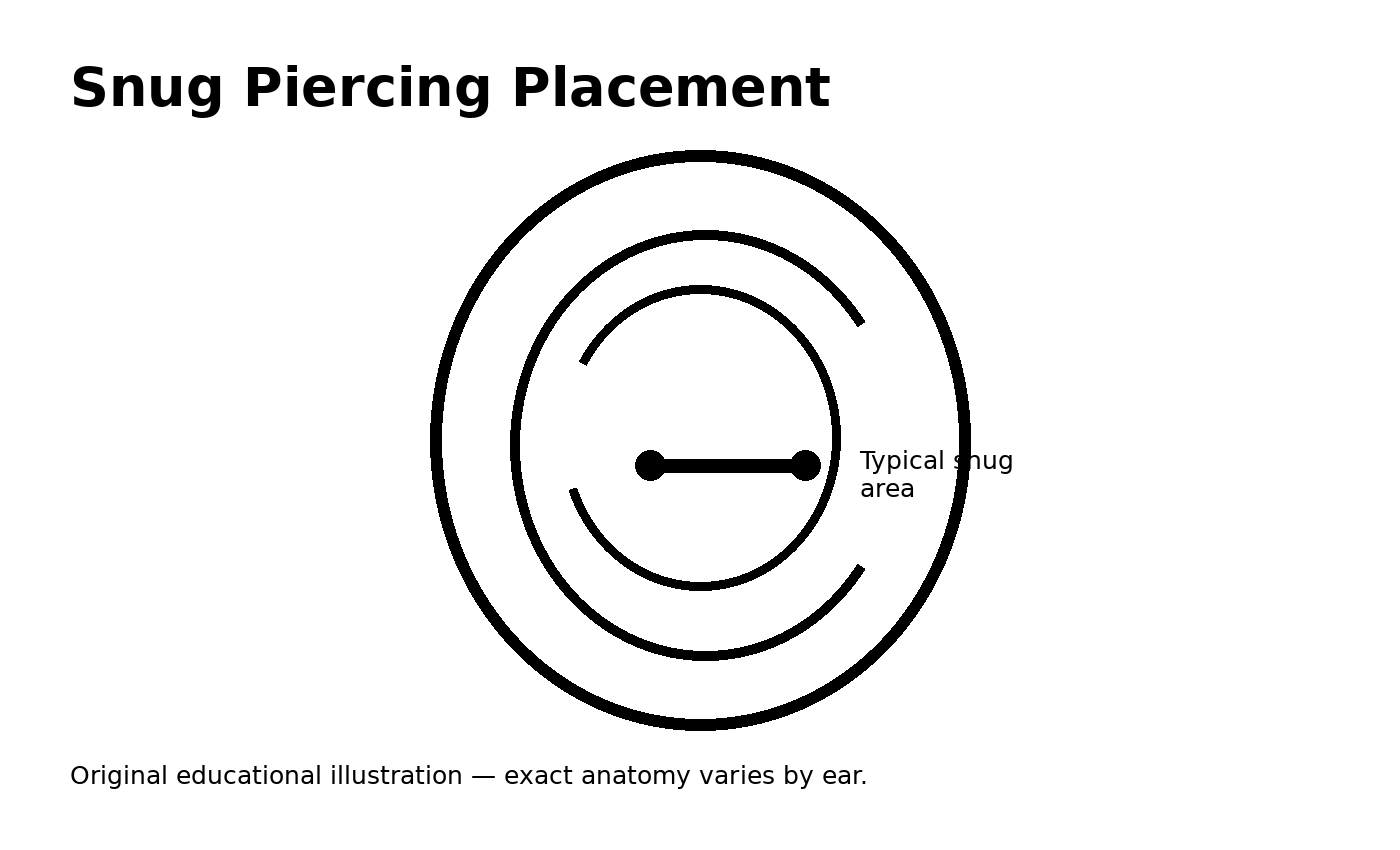
A snug piercing is a distinctive cartilage piercing placed through the inner ridge of the ear's cartilage, generally associated with the antihelix. It creates a compact, horizontal jewelry placement that looks tucked into the natural curve of the ear.

Unlike an earlobe piercing, a snug piercing passes through cartilage and therefore usually requires more patience during healing. Its position is also highly dependent on individual anatomy. Not every ear has enough suitable tissue for a traditional snug piercing, so an experienced professional should assess the ear before performing the procedure.
This guide covers placement, pain, healing time, jewelry, aftercare, swelling, bumps, infection warning signs, sleeping, headphones, cost factors, comparisons with other ear piercings, and frequently asked questions.
Where Is a Snug Piercing Located?
A snug piercing is positioned on the inner cartilage ridge of the outer ear, commonly described as the antihelix. The exact entry and exit points vary because cartilage folds differ significantly from one person to another.
A professional piercer should assess cartilage thickness, the shape of the ridge, available space for jewelry, the piercing angle, expected swelling, and how nearby structures may affect the jewelry. The goal is to work with the ear's natural anatomy rather than forcing a standard placement.
Is Every Ear Suitable for a Snug Piercing?
No. Snug piercings are particularly anatomy-dependent. Some ears have a pronounced ridge with enough tissue, while others have a flatter or thinner structure that may not safely accommodate the piercing.
A reputable piercer should be willing to decline the piercing when the anatomy is unsuitable. Depending on the ear, an alternative piercing may create a similar visual effect with less anatomical difficulty.
Snug Piercing Pain Level
Pain is subjective, but a snug piercing is generally more uncomfortable than a standard lobe piercing because it passes through cartilage. People may describe the procedure as a sharp pinch, pressure, stinging, or a brief burning sensation.
The actual needle passage is very short. The more noticeable discomfort can come later from swelling, tenderness, accidental bumps, or pressure while sleeping. Technique, cartilage thickness, jewelry fit, and individual pain tolerance all influence the experience.
Snug Piercing Pain Compared With Other Ear Piercings
A precise pain ranking cannot be guaranteed because everyone's experience is different. In general, lobe piercings are easier for most people, while cartilage placements such as helix, conch, rook, daith, and snug piercings can involve more pressure and a longer recovery period.
How Long Does a Snug Piercing Take to Heal?
A snug piercing can take approximately 6 to 12 months or sometimes longer to fully heal. Healing time varies with anatomy, jewelry quality, aftercare, pressure, accidental trauma, and individual healing response.
A piercing can look healthy on the outside before the deeper channel has completely matured. For that reason, early appearance should not be used as the only reason to change jewelry.
Snug Piercing Healing Stages
During the first few days, mild swelling, tenderness, warmth, and redness may occur. A small amount of clear or pale fluid can also be part of normal healing.
Over the following weeks, swelling should gradually settle, although the area may remain sensitive. Later, the piercing may look normal while deeper tissue continues to heal. A mature piercing should eventually become comfortable and stable, but cartilage can still become irritated by repeated trauma.
Snug Piercing Aftercare
Good aftercare is mainly about gentle cleaning and minimizing irritation.
· • Wash your hands before touching the piercing.
· • Use a sterile saline wound wash according to its instructions.
· • Do not twist, spin, or repeatedly move the jewelry.
· • Avoid rubbing or picking dried material from the piercing.
· • Keep hair, cosmetics, creams, and styling products away from the area.
· • Keep pillowcases reasonably clean.
· • Avoid sleeping directly on the piercing.
· • Avoid unnecessary contact.
· • Avoid harsh chemicals such as rubbing alcohol and hydrogen peroxide unless a healthcare professional specifically advises otherwise.
· • Follow the aftercare instructions provided by your professional piercer.

Can You Sleep on a Snug Piercing?
It is best to avoid direct pressure on a fresh snug piercing. Sleeping on it can cause swelling, soreness, irritation, jewelry movement, and delayed healing.
If you are a side sleeper, a travel pillow can sometimes reduce pressure by allowing the ear to sit in the opening. The opposite side may also be used while the piercing heals.
Snug Piercing Jewelry
Jewelry selection is especially important because the cartilage may swell during early healing. A professional should choose an appropriate length and thickness that allows for normal swelling without creating excessive pressure.

Possible jewelry styles include curved barbells, suitable straight bars, labret-style pieces, and small decorative ends. The correct style depends on the anatomy and angle of the individual piercing.
Best Metal for a Snug Piercing
High-quality body-jewelry materials are preferred for fresh piercings. Implant-grade titanium is a common choice because it is lightweight and is often suitable for people who have problems with certain metals.
High-quality solid gold can also be suitable when it meets appropriate standards for body jewelry. Gold-plated jewelry is different from solid gold and is generally not the same choice for a fresh piercing.
Material quality matters more than simply choosing a particular color or finish.
Can You Put a Hoop in a Snug Piercing?
A hoop may move more than stable bar-style jewelry and can create additional friction or pressure during healing. For that reason, many piercers prefer appropriately fitted bar-style jewelry initially.
After complete healing, jewelry can be changed if the anatomy permits it. A professional should assess the piercing before a significant jewelry change.
Snug Piercing Downsizing
After initial swelling decreases, a piercer may recommend downsizing. This means replacing the original longer jewelry with a shorter piece that better matches the reduced swelling.
Downsizing should be performed at an appropriate stage and with suitable jewelry. Avoid making an early change yourself simply because the piercing looks calm on the surface.
Snug Piercing Cost
The price varies by studio, location, piercer experience, jewelry material, jewelry design, and sterilization standards. Some studios charge separately for the procedure and jewelry.
Cost should not be the only factor when choosing a studio. Proper hygiene, professional experience, anatomy assessment, and quality jewelry are more important than finding the lowest possible price.
What Happens During a Snug Piercing?
A professional procedure generally begins with an anatomy consultation. The piercer marks the proposed placement and gives you an opportunity to check it. The area is then prepared with appropriate hygiene and sterile equipment, followed by the piercing and jewelry insertion.
A reputable professional should also explain aftercare and tell you what signs are expected during healing and what symptoms require further assessment.
Needle vs Piercing Gun
Cartilage should not be pierced with a conventional piercing gun. A professional piercer should use an appropriate sterile piercing needle and suitable sterilization procedures.
Blunt-force devices can create unnecessary trauma in cartilage, so choosing an experienced professional is especially important for a snug piercing.
Snug Piercing Swelling
Swelling can occur after a cartilage piercing, especially during the first several days. Mild redness, tenderness, warmth, and limited swelling may occur during normal healing.
Worsening swelling, severe pain, spreading redness, fever, or significant discharge are reasons to seek professional medical assessment rather than assuming the symptoms are routine healing.
Snug Piercing Bump
A bump does not automatically mean infection. Mechanical irritation, sleeping pressure, jewelry movement, trauma, or unsuitable jewelry can contribute to bumps.
Because different conditions can look similar, a persistent or worsening bump should be assessed by an experienced piercer or healthcare professional.
Infection vs Normal Healing
Normal healing can include mild tenderness, limited swelling, slight redness, and small amounts of clear or pale fluid.
Possible warning signs include increasing severe pain, rapidly worsening swelling, spreading redness, significant warmth, thick or foul-smelling discharge, fever, or feeling unwell. Cartilage infections can be more serious than ordinary irritation, so worsening symptoms deserve prompt medical attention.
Should You Remove an Infected Snug Piercing?
Do not automatically remove jewelry when you suspect an infection. Removing jewelry can sometimes allow the surface to close while an infection remains underneath.
If infection is suspected, seek advice from a healthcare professional before deciding whether the jewelry should be removed.
Snug Piercing Scarring
Any piercing can leave a scar. Risk varies with genetics, technique, trauma, infection, and jewelry pressure. Some people are more prone to raised scars such as keloids.
If you have previously developed significant raised scars after injuries or piercings, discuss this with a healthcare professional before getting another piercing.
Can a Snug Piercing Migrate or Reject?
Migration means that a piercing gradually shifts from its original position. Tissue thinning and other rejection-like changes can be associated with unsuitable anatomy, excessive pressure, repeated trauma, or jewelry problems.
If the jewelry appears to move toward the surface or the tissue between the openings becomes noticeably thinner, have it assessed by a professional.
Snug Piercing and Headphones
Headphones can create pressure and friction around healing cartilage. Over-ear headphones may press directly on the piercing, while some earbuds may also contact nearby tissue.
During healing, use audio equipment that does not put pressure on the jewelry. Comfort and reduced friction are more important than continuing to use a particular device.
Snug Piercing and Hair
Hair can catch on cartilage jewelry and create sudden pulling. Be careful when brushing, washing, drying, and styling hair.
Keeping hair away from the piercing during early healing can reduce accidental trauma.
Can You Swim After a Snug Piercing?
It is generally best to avoid swimming while a fresh piercing is healing. Pools, hot tubs, lakes, rivers, and oceans can expose a healing piercing to microorganisms and contaminants.
If swimming cannot be avoided, ask your professional piercer or healthcare professional about appropriate precautions.
Can You Shower With a Snug Piercing?
Normal showering is generally possible. Let clean water rinse the area and avoid aggressive scrubbing.
After showering, gently dry around the piercing without rubbing or catching the jewelry on a towel.
Makeup and Skincare Around a Snug Piercing
Avoid applying makeup, creams, oils, or other cosmetic products directly around a fresh piercing. Product residue can irritate healing tissue.
When using skincare products nearby, leave enough distance from the piercing and avoid getting product into the openings.
Snug Piercing During Exercise
Exercise itself does not necessarily prevent healing, but sweat, friction, and accidental contact can irritate cartilage. Be careful with helmets, headbands, sports equipment, towels, and other items that contact the ear.
Snug Piercing and Glasses
If you wear glasses, check whether the frame touches the piercing. Repeated pressure from the glasses arm can cause irritation.
If there is consistent contact, ask your piercer to evaluate the jewelry and placement.
Snug Piercing for Different Ear Shapes
A snug piercing can look different from one ear to another. A pronounced antihelix may produce a more visible jewelry placement, while a smaller ridge can create a subtle appearance.
Ear size, cartilage thickness, ridge shape, piercing angle, and jewelry design all affect the final result. A reference photo can inspire a style, but it cannot guarantee the same placement on another ear.
Right Ear or Left Ear?
There is no universal rule requiring the right or left ear. Consider your anatomy, existing piercings, sleeping habits, and personal style.
If one ear has more suitable anatomy, that may be the better choice even if you initially preferred the other side.
Can You Get Both Snug Piercings at Once?
Some people may choose bilateral snug piercings, but healing both sides at the same time can make sleeping difficult. If you normally sleep on either side, having both ears healing simultaneously can create a significant pressure problem.
Many people prefer to heal one side before considering the other.
Snug Piercing vs Helix
A helix piercing is located on the outer cartilage rim, while a snug is positioned farther inward along the antihelix. Both can require patience, but snug placement is particularly dependent on ear anatomy.
A helix often offers more jewelry flexibility, while a snug provides a more tucked-in appearance.
Snug Piercing vs Rook
A rook piercing passes through an upper inner cartilage fold, while a snug sits lower along the antihelix ridge. Both are anatomy-dependent and should be assessed individually rather than selected solely from photographs.
Snug Piercing vs Daith
A daith piercing is placed through a cartilage fold near the ear canal, whereas a snug is positioned on the antihelix. Their locations, jewelry angles, and anatomical requirements are different.
Does a Snug Piercing Help With Migraines?
You may encounter claims that ear piercings can treat migraines, anxiety, or other medical conditions. A snug piercing should not be considered an established medical treatment for migraines.
If you experience migraines or another medical problem, speak with an appropriate healthcare professional rather than relying on a piercing as treatment.
Can a Snug Piercing Affect Hearing?
A properly performed external ear cartilage piercing should not normally change hearing. However, complications from an improperly performed procedure can require medical attention.
If you experience sudden hearing changes, severe pain, major swelling, or other concerning symptoms after a piercing, seek medical evaluation.
Pros and Cons of a Snug Piercing
Is a Snug Piercing Worth It?
For someone with suitable anatomy who is prepared for a long healing period, a snug piercing can be a striking addition to an ear-piercing collection.
It is not the easiest cartilage piercing, so timing matters. If you frequently sleep on your side, wear tight headphones, participate in contact sports, or cannot consistently follow aftercare instructions, consider whether you are ready for the commitment.
The safest approach is to prioritize anatomy, professional placement, quality jewelry, and healthy healing over speed.
Snug Piercing Comparison Table
Piercing | Typical Location | Tissue | General Difficulty | Typical Healing* |
Earlobe | Lower ear | Soft tissue | Low | About 6–8 weeks |
Helix | Outer ear rim | Cartilage | Moderate | Several months |
Conch | Central ear bowl | Cartilage | Moderate | Several months |
Daith | Inner cartilage fold | Cartilage | Moderate–high | Several months |
Rook | Upper inner cartilage fold | Cartilage | High | Several months |
Snug | Antihelix / inner ridge | Cartilage | High | 6–12+ months |
Industrial | Two connected cartilage points | Cartilage | High | Often many months |
*Healing times are general estimates and can vary significantly by person and piercing.
Snug Piercing Aftercare Checklist
· Wash hands before touching the area.
· Use sterile saline according to professional instructions.
· Do not twist or rotate the jewelry.
· Avoid direct pressure while sleeping.
· Keep hair and cosmetics away from the piercing.
· Avoid harsh cleaning products.
· Avoid unnecessary touching and picking.
· Do not change jewelry prematurely.
· Keep headphones, helmets, and other equipment from pressing on the area.
· Seek professional or medical advice if symptoms worsen.
Frequently Asked Questions About Snug Piercing
Is a snug piercing painful?
It can be more uncomfortable than an earlobe piercing because it passes through cartilage. The procedure is brief, but tenderness can continue during early healing.
How long does a snug piercing take to heal?
Many snug piercings require approximately 6 to 12 months or longer to fully heal.
Is a snug piercing suitable for everyone?
No. The piercing is highly anatomy-dependent, and some ears do not have enough suitable cartilage.
Can you sleep on a snug piercing?
It is best to avoid direct pressure while the piercing is healing.
What jewelry is best for a new snug piercing?
A professional should choose appropriately sized, high-quality jewelry based on anatomy and swelling. Implant-grade titanium is a common option.
Can I put a hoop in a snug piercing?
A hoop may create extra movement and friction during healing. Discuss timing and fit with your piercer.
Why is my snug piercing still sore?
Cartilage can remain tender for months, especially after pressure or accidental trauma. Worsening or severe pain should be evaluated.
Why is there a bump on my snug piercing?
Irritation, pressure, trauma, jewelry movement, and other causes can produce bumps. Persistent or worsening bumps should be assessed.
Can I clean a snug piercing with alcohol?
Alcohol can irritate healing tissue and is generally not the preferred routine cleaning method.
Can I use hydrogen peroxide?
It can irritate healing tissue and is generally not recommended as routine piercing aftercare.
Can I swim with a new snug piercing?
It is generally better to avoid swimming during early healing because water can introduce microorganisms and contaminants.
Can a snug piercing get infected?
Yes. Any piercing can become infected. Increasing pain, spreading redness, severe swelling, fever, or significant discharge warrant medical attention.
Should I remove jewelry if I think it is infected?
Do not automatically remove it. Seek medical advice before deciding what to do with the jewelry.
Can a snug piercing leave a scar?
Yes. Any piercing can scar, and risk varies between individuals.
Can a snug piercing migrate?
It can change position or experience tissue thinning, especially with pressure, trauma, unsuitable jewelry, or poor placement.
Can a snug piercing affect hearing?
A properly performed external cartilage piercing should not normally affect hearing. Sudden hearing changes require medical evaluation.
Does a snug piercing help migraines?
It should not be considered an established treatment for migraines or other medical conditions.
Can I wear headphones with a snug piercing?
Avoid devices that press or rub against the fresh piercing.
How do I know if it is fully healed?
It should be comfortable and stable without ongoing tenderness, swelling, or discharge, but deeper healing can take longer than the outside appearance suggests.
When can I change the jewelry?
Have a professional assess the piercing before making a significant jewelry change, especially during the long cartilage-healing period.
Leave a Reply