

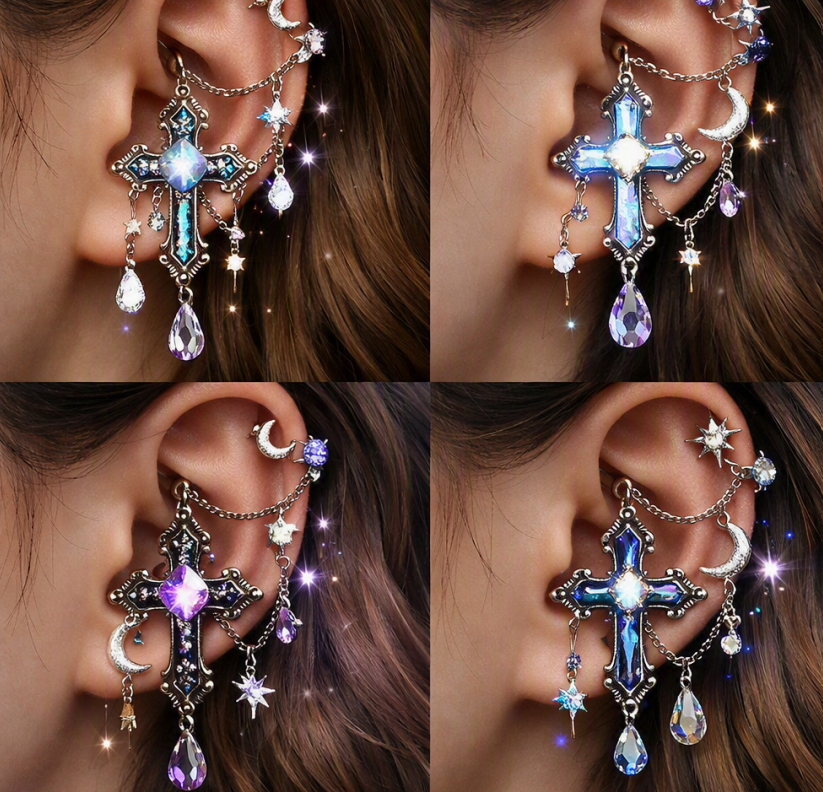

The Magic Cross Piercing is a distinctive ear-piercing style created around a cross-shaped visual arrangement. It has attracted attention among people who enjoy creative ear styling because it looks different from a conventional single cartilage or lobe piercing.

A carefully planned Magic Cross Piercing can become the focal point of an ear-curation setup. At the same time, it should not be treated like an ordinary fashion accessory. Depending on the configuration, it can involve more than one cartilage piercing, which means placement, jewelry quality, hygiene and healing care are especially important.
This complete guide explains what a Magic Cross Piercing is, how the design works, where it may be placed, what it can mean, how much it may hurt, how long healing can take, which jewelry options are commonly considered, how to care for it, what complications to watch for, how much it may cost, and how to choose a professional piercer.
IMPORTANT NOTE: The name “Magic Cross Piercing” is not a universally standardized medical term. Different studios, creators and piercing communities may use the name for somewhat different cross-shaped configurations. Always show your piercer a reference image and confirm the exact placement before the procedure.
Table Of Contents
1. What Is a Magic Cross Piercing?
2. Why Is It Called a Magic Cross Piercing?
3. What Does a Magic Cross Piercing Look Like?
4. Magic Cross Piercing Placement
5. Does Ear Anatomy Matter?
6. Magic Cross Piercing Meaning and Symbolism
7. Is It a Cartilage Piercing?
8. How Much Does a Magic Cross Piercing Hurt?
9. What Happens During the Piercing Appointment?
10. Magic Cross Piercing Healing Time
11. What Normal Healing Can Look Like
12. Magic Cross Piercing Aftercare
13. How to Clean a Magic Cross Piercing
14. What Should You Avoid During Healing?
15. Infection vs. Irritation
16. Possible Risks and Complications
17. Choosing Magic Cross Piercing Jewelry
18. Titanium, Steel and Gold Jewelry
19. Jewelry Size, Shape and Weight
20. When Can You Change the Jewelry?
21. Sleeping With a Magic Cross Piercing
22. Headphones, Earbuds and Daily Activities
23. Swimming, Exercise and Hair Care
24. Can You Get the Piercing on Both Ears?
25. Piercing Bumps, Migration and Scarring
26. Magic Cross Piercing Cost
27. How to Choose a Professional Piercer
28. Pros and Cons
29. Is It Suitable for Beginners?
30. Styling Ideas and Ear Curation
31. Magic Cross Piercing for Men and Women
32. Makeup, Skincare and Showering
33. What to Do After Accidental Trauma
34. Common Aftercare Mistakes
35. Frequently Asked Questions
36. Final Thoughts
37. WHAT IS A MAGIC CROSS PIERCING?
A Magic Cross Piercing is an ear-piercing arrangement designed to create the appearance of a cross. Instead of looking like one isolated piercing, the jewelry is positioned in a coordinated way so that the overall composition forms a cross-like design.
The exact construction can differ. Some designs may use multiple cartilage piercings with separate jewelry pieces, while another design may use a combination that creates a cross visually from different angles. Because there is no single universal technical definition, the exact method should always be confirmed with the piercer.
The appeal is largely visual. People who enjoy alternative jewelry, geometric ear styling or symbolic designs may find the Magic Cross Piercing particularly interesting.
A good result depends on more than the jewelry itself. The piercer must consider the natural shape of the ear, available cartilage, spacing, jewelry dimensions and the way the finished design will sit after swelling decreases.
For that reason, a photograph is useful for communication, but it should not be treated as a template that must be copied exactly. Human ears are different, and a safe design may require small changes.
38. WHY IS IT CALLED A MAGIC CROSS PIERCING?
The name mainly describes the visual concept. When the jewelry is arranged correctly, the pieces can create a cross-shaped impression on the ear.
The word “magic” is part of the style name rather than a medical description. It gives the design a memorable identity and distinguishes it from a standard helix, conch or lobe piercing.
The name does not automatically indicate a particular religion or belief system. The wearer may choose the design for its symbolism, its geometric appearance, its alternative aesthetic, or simply because they like the way it looks.
39. WHAT DOES A MAGIC CROSS PIERCING LOOK LIKE?
The finished appearance is usually the most attractive part of this piercing style. The coordinated jewelry can create a strong geometric focal point on the ear.
A minimalist design may use small metal ends and a clean, symmetrical appearance. A more decorative design may use gemstones, polished ends or contrasting jewelry.
The overall look can be:
· Minimalist and clean
· Alternative and edgy
· Elegant and understated
· Bold and dramatic
· Spiritual or symbolic
· Decorative and glamorous
· Modern and geometric
The best style depends on your existing jewelry and the shape of your ear.
If you already have several lobe, helix or conch piercings, the Magic Cross design can potentially become the central feature of a larger ear-curation arrangement. However, adding more jewelry is not always better. Spacing and balance matter.
40. MAGIC CROSS PIERCING PLACEMENT
Placement is one of the most important parts of the entire process.
A professional piercer should first examine the ear and determine whether the desired configuration is realistic for your anatomy. The exact location can vary according to cartilage ridges, thickness, folds and existing piercings.
A design that looks symmetrical on one person's ear may need to be adjusted on another person's ear.
The piercer may consider:
· Upper-ear cartilage
· Helix structure
· Available flat surface
· Existing jewelry
· Cartilage thickness
· Jewelry length and diameter
· Possible pressure points
· Sleeping habits
· Headphone use
· Desired final appearance
A safe piercing should not be positioned only for the photograph. The jewelry also needs enough room to accommodate normal initial swelling and healing.
41. DOES EAR ANATOMY MATTER?
Yes. Ear anatomy is extremely important for a complex cartilage design.
The shape, size and thickness of cartilage vary from person to person. Some people may have plenty of suitable space for a particular cross-shaped arrangement, while others may need a modified design.
A professional piercer should be comfortable saying that a particular configuration is not suitable if the anatomy does not support it.
This is not a failure. Adjusting the design to the ear can produce a better long-term result.
Existing piercings can also affect the available space. If two placements are too close together, swelling and pressure can become more difficult to manage.
42. MAGIC CROSS PIERCING MEANING AND SYMBOLISM
There is no single universal meaning attached to the Magic Cross Piercing.
The cross is a symbol that can have religious, spiritual, cultural and personal significance. Some people may associate it with faith, protection, strength, remembrance or personal values. Others may simply enjoy the shape.
Body jewelry is highly individual. The same design can mean something completely different to two people.
If the cross has personal meaning for you, the piercing can become more than a fashion choice. If you do not attach symbolic meaning to it, that is equally valid.
The most accurate meaning is the one the wearer personally gives to the design.
43. IS IT A CARTILAGE PIERCING?
Many Magic Cross configurations involve ear cartilage, so they should be approached with the expectations associated with cartilage healing.
Cartilage generally heals more slowly than a soft earlobe. It can also be more sensitive to pressure, friction and accidental knocks.
This is why a complex cross-shaped cartilage design requires patience.
Do not assume that because the piercing feels comfortable after a few weeks it is fully healed. A piercing can look calm externally while deeper tissue is still healing.
44. HOW MUCH DOES A MAGIC CROSS PIERCING HURT?
Pain varies considerably between individuals.
Many people describe cartilage piercing as a quick pinch, pressure or sharp sensation. The actual piercing is usually very brief, but the area can remain tender afterward.
A general description of the experience is moderate discomfort, but it should never be presented as a guaranteed pain score.
Pain can be influenced by:
· Individual pain tolerance
· Exact placement
· Number of piercing sites
· Cartilage thickness
· Piercing technique
· Anxiety and stress
· Accidental pressure
· Previous piercing experience
It is normal to feel nervous before a piercing. A good professional should explain the process clearly so you know what to expect.
45. WHAT HAPPENS DURING THE PIERCING APPOINTMENT?
A responsible appointment should begin with consultation rather than immediately piercing the ear.
The piercer may:
46. Discuss the desired design.
47. Examine the ear anatomy.
48. Explain possible limitations.
49. Mark the proposed placement.
50. Let you review the markings.
51. Prepare sterile equipment.
52. Perform the piercing.
53. Insert appropriate initial jewelry.
54. Explain aftercare and healing expectations.
Do not hesitate to ask questions before the procedure.
A professional should also be willing to change the proposed design if the markings do not look appropriate or if the anatomy creates a concern.
55. MAGIC CROSS PIERCING HEALING TIME
Cartilage healing can take several months, and the exact time differs from person to person.
A useful general expectation is that a cartilage piercing may need many months to heal fully. More complex arrangements can require additional patience, particularly if multiple sites are healing at the same time.
Factors that may influence healing include:
· Individual healing ability
· Placement
· Number of piercings
· Jewelry quality
· Jewelry fit
· Friction
· Pressure
· Accidental trauma
· Aftercare
· Overall lifestyle
Do not change jewelry simply because the piercing looks healed from the outside.
A professional piercer can check whether the tissue is ready for a jewelry change or downsize.
56. WHAT NORMAL HEALING CAN LOOK LIKE
During early healing, some temporary tenderness, mild swelling or light crusting may occur.
Normal healing can include:
· Mild tenderness
· Limited swelling
· Mild redness near the piercing
· Temporary sensitivity
· Small amounts of clear or pale fluid
· Light crusting
The important factor is the overall trend. Healing symptoms should generally become calmer over time.
If pain, swelling or redness becomes progressively worse, seek professional advice rather than assuming it is normal.
57. MAGIC CROSS PIERCING AFTERCARE
Aftercare is essential.
The basic principle is simple: keep the piercing reasonably clean, minimize irritation, and give the tissue enough time to heal.
Helpful practices include:
· Wash your hands before touching the area.
· Use appropriate sterile saline as directed by your piercer.
· Avoid unnecessary touching.
· Do not twist or rotate jewelry unnecessarily.
· Avoid sleeping directly on the fresh piercing.
· Keep hair from repeatedly catching on jewelry.
· Be careful with headphones and helmets.
· Keep cosmetics and styling products away from the fresh piercing.
· Follow the aftercare instructions provided by your professional.
Good aftercare is not about doing more. It is about doing the right things consistently.
58. HOW TO CLEAN A MAGIC CROSS PIERCING
A fresh piercing should be handled gently.
Use an appropriate sterile saline wound-care product according to the product instructions and your piercer's guidance.
Do not aggressively scrub the jewelry or surrounding tissue.
Avoid repeatedly using harsh household chemicals because you think stronger cleaning will make healing faster. Excessive cleaning can itself cause irritation.
After cleaning or showering, gently dry the surrounding area with a clean disposable product or another method recommended by your piercer.
Do not pick crusts aggressively. Allow normal healing material to soften and come away naturally during gentle cleaning.
59. WHAT SHOULD YOU AVOID DURING HEALING?
Several common activities can increase irritation.
Avoid:
· Sleeping directly on the piercing
· Repeatedly touching the jewelry
· Twisting the jewelry
· Changing jewelry too early
· Pulling hair through the jewelry
· Wearing equipment that presses against the ear
· Swimming too soon
· Applying cosmetics directly to the wound
· Using harsh cleaning chemicals
· Allowing dirty hands to contact the piercing
The objective is to minimize unnecessary trauma.
60. INFECTION VS. IRRITATION
Not every uncomfortable piercing is infected.
Irritation can happen because of pressure, friction, jewelry movement, sleeping on the ear, hair catching on the jewelry or over-cleaning.
Possible warning signs of infection can include increasing pain, significant swelling, warmth, spreading redness, concerning discharge or feeling generally unwell.
Because infection can require medical treatment, do not rely on photographs or online descriptions to diagnose it.
If symptoms are severe, rapidly worsening or accompanied by fever or other systemic symptoms, seek medical care promptly.
61. POSSIBLE RISKS AND COMPLICATIONS
Every piercing carries some risk.
Possible problems include:
· Irritation
· Infection
· Swelling
· Allergic or sensitivity reactions to unsuitable jewelry
· Prolonged tenderness
· Piercing bumps
· Scarring
· Migration
· Rejection in some circumstances
· Jewelry embedding
· Trauma from accidental impact
Risk can be reduced by choosing a qualified professional, suitable jewelry and appropriate aftercare, but no piercing is completely risk-free.
If jewelry becomes embedded or the tissue develops severe swelling, do not try to force the jewelry out yourself.
62. CHOOSING MAGIC CROSS PIERCING JEWELRY
Jewelry can completely change the appearance of the finished design.
Common options may include:
· Straight barbells
· Labret-style jewelry
· Titanium jewelry
· Suitable gold body jewelry
· Decorative ends
· Gemstone ends
· Simple polished balls
· Dark or contrasting finishes
The exact jewelry depends on the piercing configuration.
For a fresh piercing, jewelry should be chosen primarily for suitability, quality and fit rather than appearance alone.
A heavy or poorly fitted piece may create unnecessary pressure.
63. TITANIUM, STEEL AND GOLD JEWELRY
High-quality implant-grade titanium is widely used for body piercing because it is lightweight and suitable for many people.
Steel jewelry is also used in body piercing, but quality and specification matter. Not every inexpensive metal product is appropriate for a fresh piercing.
Gold can be an attractive option, but jewelry intended for a fresh piercing should be appropriate for body piercing and made to suitable standards. Plating and low-quality finishes can create problems if they wear away.
Ask your piercer about the exact material and manufacturing quality rather than choosing based only on color.
64. JEWELRY SIZE, SHAPE AND WEIGHT
Jewelry needs to fit the individual piercing.
Too-tight jewelry can put pressure on healing tissue. Jewelry that is unnecessarily long can catch on hair or clothing and may be more vulnerable to accidental movement.
Weight also matters.
Large decorative pieces may look attractive but can be less practical during healing.
A professional piercer should choose initial jewelry with expected swelling and healing in mind and may recommend a later downsize when appropriate.
65. WHEN CAN YOU CHANGE THE JEWELRY?
Do not use a calendar alone to decide when to change healing cartilage jewelry.
The correct time depends on the actual condition of the piercing.
A professional can assess:
· Swelling
· Tissue condition
· Tenderness
· Jewelry fit
· Healing progress
· Whether downsizing is appropriate
If the initial jewelry needs adjustment because it is too long or otherwise problematic, contact the piercer instead of changing it yourself.
66. SLEEPING WITH A MAGIC CROSS PIERCING
Sleeping can be one of the biggest challenges during cartilage healing.
Direct pressure can irritate the piercing and make it sore.
If possible, sleep on the opposite side during the early healing period.
Some people find a travel pillow useful because the ear can sit inside the opening rather than directly against the pillow.
Keeping pillowcases clean is also a sensible hygiene practice.
67. HEADPHONES, EARBUDS AND DAILY ACTIVITIES
Headphones can rub against cartilage jewelry.
Over-ear headphones may press directly on the outer ear, while some earbuds may be close to particular piercing locations.
If a device causes pressure, pain or repeated friction, stop using it around the healing area or choose an alternative that does not touch the piercing.
Helmets, hats and other equipment can also create pressure.
Think about your normal daily routine before choosing the exact placement.
68. SWIMMING, EXERCISE AND HAIR CARE
Fresh piercings should be protected from potentially contaminated water.
Many professional aftercare recommendations advise avoiding swimming and hot tubs during early healing. Follow your piercer's specific instructions.
Exercise is generally possible, but be careful with contact sports and equipment that can hit the ear.
Hair can also become a problem. Long hair may catch on jewelry, especially when brushing or washing.
Hair sprays, oils, gels and other styling products should be kept away from healing tissue.
69. CAN YOU GET THE PIERCING ON BOTH EARS?
It may be possible if both ears have suitable anatomy.
However, healing both ears at the same time can be inconvenient because sleeping becomes more difficult.
If both ears are healing simultaneously, you may have very limited options for comfortable side sleeping.
Some people prefer to complete healing on one ear before starting a complex design on the other.
Discuss your lifestyle and sleeping habits with the piercer before deciding.
70. PIERCING BUMPS, MIGRATION AND SCARRING
A bump near a piercing can have several possible causes.
Irritation, pressure, trauma and jewelry problems can all contribute to bumps.
Not every bump is a keloid. A keloid is a specific type of raised scar tissue that can extend beyond the original wound area.
Migration refers to movement of a piercing from its original location. If the tissue appears to be thinning or the jewelry seems to be moving, have it evaluated.
Any piercing can also leave a small mark after removal. Individual scar formation varies.
71. MAGIC CROSS PIERCING COST
The cost varies widely depending on location, studio, piercer experience, jewelry, number of piercing sites and complexity.
A simple service fee may not include premium jewelry.
Before booking, ask for the complete price and find out whether it includes:
· Piercing service
· Initial jewelry
· Aftercare instructions
· Follow-up
· Downsizing, if applicable
· Taxes or other studio charges
Do not choose a professional solely because they offer the lowest price.
A clean studio, experienced piercer and appropriate jewelry are more important than saving a small amount of money.
72. HOW TO CHOOSE A PROFESSIONAL PIERCER
A complex ear design deserves careful planning.
Look for a professional who:
· Has experience with cartilage piercings
· Can explain anatomy and placement
· Uses appropriate sterile equipment
· Uses high-quality jewelry
· Provides written or clear aftercare guidance
· Shows healed examples of their work
· Does not pressure customers
· Is willing to modify the design for anatomy
· Answers questions clearly
Ask to see healed work when possible. A fresh piercing can look excellent immediately after placement, but healed results provide more useful information.
73. MAGIC CROSS PIERCING PROS
Potential advantages include:
74. Unique appearance: The cross-shaped design can stand out from conventional piercings.
75. Customizable style: Jewelry can be changed after healing to create different looks.
76. Personal symbolism: The cross may have personal or spiritual meaning.
77. Ear-curation potential: It can work as a focal point within a coordinated jewelry arrangement.
78. Creative expression: It offers an option for people who enjoy unusual geometric designs.
79. MAGIC CROSS PIERCING CONS
Potential disadvantages include:
80. Longer healing: Cartilage can take months to heal.
81. More complex planning: The placement must work with individual anatomy.
82. Pressure sensitivity: Sleeping and headphones may become difficult.
83. Maintenance: Healing requires consistent care.
84. Risk of irritation: Friction and trauma can delay healing.
85. Cost: Multiple piercing sites and premium jewelry can increase the total price.
86. IS IT SUITABLE FOR BEGINNERS?
It can be suitable for some beginners, but it is not necessarily the simplest first piercing.
Someone who has never had cartilage pierced should understand that healing may be considerably more demanding than a basic earlobe piercing.
A professional may recommend a simpler arrangement if your anatomy, work environment, sleeping habits or daily routine make the design difficult.
There is no benefit in rushing into a complex piercing if the conditions are not suitable.
87. STYLING IDEAS AND EAR CURATION
A Magic Cross Piercing can be styled in many ways after healing.
For a minimalist ear, pair it with small lobe studs.
For a more decorative ear, combine it with coordinated gemstone pieces.
For an alternative look, dark metal or contrasting finishes can make the geometric design more noticeable.
Try to create visual balance.
For example, if the cross design is already large and dramatic, smaller surrounding jewelry may help keep it as the focal point.
If the design is very small, additional lobe or helix jewelry can create a more layered appearance.
88. MAGIC CROSS PIERCING FOR MEN AND WOMEN
The style is not restricted to one gender.
Men may prefer simple titanium, black or silver-toned jewelry, while women may choose gemstone or decorative options. However, these are only style possibilities, not rules.
Anyone can choose the jewelry that matches their personality.
The important considerations are anatomy, jewelry suitability and personal preference.
89. MAKEUP, SKINCARE AND SHOWERING
Keep makeup, creams, oils and skincare products away from fresh piercing openings.
During a shower, avoid aggressively rubbing the area.
Hair products should also be kept away from the healing tissue.
After showering, gently dry the area without pulling or twisting the jewelry.
90. WHAT TO DO AFTER ACCIDENTAL TRAUMA
Accidental knocks are common.
If the piercing is bumped, first avoid repeatedly touching it.
Check whether there is:
· Significant bleeding
· Severe pain
· Sudden swelling
· Obvious jewelry displacement
· Visible tissue damage
A minor bump may simply cause temporary tenderness.
However, significant trauma should be evaluated by a professional, especially if the jewelry becomes displaced or the tissue looks damaged.
91. COMMON AFTERCARE MISTAKES
OVER-CLEANING
More cleaning does not automatically mean faster healing. Excessive cleaning can irritate tissue.
TOUCHING TOO MUCH
Constantly checking the jewelry with your fingers can introduce contamination and cause friction.
SLEEPING ON THE PIERCING
Repeated pressure can prolong irritation.
CHANGING JEWELRY TOO EARLY
Healing tissue can be damaged by unnecessary jewelry changes.
USING POOR-QUALITY JEWELRY
Unsuitable materials, rough surfaces or incorrect sizing can create problems.
IGNORING WORSENING SYMPTOMS
Persistent or worsening pain, swelling, heat or concerning discharge should be assessed.
92. FREQUENTLY ASKED QUESTIONS
Q: Is Magic Cross Piercing painful?
A: It can cause moderate discomfort because cartilage may be involved. The exact experience varies by person and placement.
Q: How long does Magic Cross Piercing take to heal?
A: Healing can take several months, and some cartilage piercings can take longer. The exact time depends on placement, anatomy, jewelry, aftercare and individual healing.
Q: Is Magic Cross Piercing safe?
A: No piercing is completely risk-free. Having it performed by a qualified professional with appropriate sterile equipment and suitable jewelry can reduce avoidable risks.
Q: Can I sleep on a Magic Cross Piercing?
A: Direct pressure is best avoided during healing. Sleeping on the opposite side or using a suitable travel pillow may help.
Q: What is the best jewelry for Magic Cross Piercing?
A: High-quality body-piercing jewelry, such as suitable implant-grade titanium, is commonly considered a good option. Your piercer should select the correct size and style.
Q: Can I change the jewelry after a few weeks?
A: Do not assume it is ready based only on time. Have the piercing assessed before making changes.
Q: Can I swim after getting a Magic Cross Piercing?
A: Fresh piercings should generally be protected from potentially contaminated water during early healing. Follow your piercer's instructions.
Q: Why is my Magic Cross Piercing swollen?
A: Some swelling can occur during early healing. Severe, increasing or persistent swelling should be assessed by a qualified professional.
Q: Why does my piercing still hurt?
A: Cartilage can remain sensitive for a significant period. Pressure, friction and accidental trauma can also cause tenderness. Worsening pain deserves attention.
Q: Should I rotate the jewelry?
A: Unnecessary rotation can irritate healing tissue and is generally best avoided.
Q: Can I use alcohol to clean it?
A: Harsh products can irritate healing tissue. Follow appropriate professional aftercare guidance rather than experimenting with strong chemicals.
Q: Can Magic Cross Piercing get infected?
A: Yes. Any piercing can become infected. Increasing pain, swelling, warmth, spreading redness, concerning discharge or systemic symptoms should be taken seriously.
Q: What should I do if I think it is infected?
A: Seek advice from a qualified healthcare professional, particularly if symptoms are severe or worsening. Do not rely only on internet diagnosis.
Q: Can men get a Magic Cross Piercing?
A: Yes. The design is suitable for anyone whose anatomy supports the desired configuration.
Q: Can women get a Magic Cross Piercing?
A: Yes. Jewelry can be customized to different personal styles.
Q: Does Magic Cross Piercing have a religious meaning?
A: It can have personal or spiritual meaning for some wearers, but there is no single universal meaning. Some people choose it simply because they like the design.
Q: Can I get it on both ears?
A: Potentially, if both ears have suitable anatomy. Healing both ears simultaneously can make sleeping more difficult.
Q: Will it leave a scar?
A: Any piercing can leave a mark. The final appearance depends on individual healing, trauma, infection, scar formation and how long the piercing was worn.
Q: What is a piercing bump?
A: A bump can develop because of irritation, pressure, trauma or other causes. Not every bump is a keloid.
Q: Can I wear headphones?
A: Avoid headphones that press or rub against the healing piercing. Choose equipment that does not create pressure.
Q: Can I exercise?
A: Exercise can usually be continued with reasonable precautions. Avoid contact, dirty equipment and activities that repeatedly hit the ear.
Q: How much does a Magic Cross Piercing cost?
A: Prices vary by studio, location, jewelry and complexity. Ask the studio for a complete price before booking.
Q: Is Magic Cross Piercing good for beginners?
A: It can be, but it may be more demanding than a simple lobe piercing. Discuss your anatomy and lifestyle with a professional first.
Q: Can I wear makeup near it?
A: Avoid getting makeup and skincare products into or directly around a fresh piercing.
Q: What if the jewelry gets stuck?
A: Do not force it. Contact your piercer or seek medical care if the jewelry is embedded or the tissue is significantly swollen.
Q: Can I remove the piercing whenever I want?
A: You can retire a piercing, but if there is a suspected infection or significant complication, seek professional advice before removing jewelry.

FINAL THOUGHTS
The Magic Cross Piercing is an unusual and visually striking way to personalize an ear. Its cross-shaped appearance can create a strong focal point and can be adapted to minimalist, alternative, elegant or decorative jewelry styles.
The most important thing is to treat the piercing as a healing body modification rather than simply as a fashion accessory.
Before booking, consider your ear anatomy, daily routine, sleeping position, headphone use, work requirements, budget and willingness to follow aftercare instructions.
Choose a professional who prioritizes anatomy, sterile technique, jewelry quality and long-term healing rather than simply copying a photograph.
Remember that healing takes patience. Avoid unnecessary touching and pressure, do not rush jewelry changes, and pay attention to symptoms that are getting worse rather than better.
With careful planning and responsible aftercare, a Magic Cross Piercing can become a distinctive and personalized part of an ear-curation setup.
Seo Information
Primary Keyword:
Magic Cross Piercing
Secondary / Semantic Keywords:
Magic Cross Ear Piercing
Cross Cartilage Piercing
Magic Cross Piercing Placement
Magic Cross Piercing Meaning
Magic Cross Piercing Pain
Magic Cross Piercing Healing Time
Magic Cross Piercing Aftercare
Magic Cross Piercing Jewelry
Magic Cross Piercing Cost
Cross Ear Piercing
Cartilage Piercing
Ear Piercing Jewelry
Ear Piercing Aftercare
Cartilage Piercing Healing
Ear Curation
Suggested SEO Title:
Magic Cross Piercing: Pain, Healing, Meaning, Jewelry & Aftercare
Suggested Meta Description:
Learn everything about Magic Cross Piercing, including placement, meaning, pain level, healing time, jewelry, aftercare, risks, cost and expert tips.
Suggested URL Slug:
magic-cross-piercing
Suggested Image Alt Text:
Magic Cross Piercing on upper ear with cross-shaped jewelry
Suggested Image File Names:
magic-cross-piercing-guide.png
magic-cross-ear-piercing-jewelry.png
Suggested FAQ Schema Questions:
What is a Magic Cross Piercing?
How painful is a Magic Cross Piercing?
How long does a Magic Cross Piercing take to heal?
What jewelry is best for a Magic Cross Piercing?
How much does a Magic Cross Piercing cost?
Can you sleep on a Magic Cross Piercing?
Can a Magic Cross Piercing get infected?
Is Magic Cross Piercing suitable for beginners?
Original Custom Images for the Article
Original custom infographic visual for Magic Cross Piercing
Publishing Checklist
SEO Element | Recommended Value |
Primary keyword | Magic Cross Piercing |
SEO title | Magic Cross Piercing: Pain, Healing, Meaning, Jewelry & Aftercare |
URL slug | magic-cross-piercing |
Meta description | Learn everything about Magic Cross Piercing, including placement, meaning, pain level, healing time, jewelry, aftercare, risks, cost and expert tips. |
Image alt text | Magic Cross Piercing on upper ear with cross-shaped jewelry |
Content type | Informational / evergreen |
Magic Cross Piercing Healing Timeline
Understanding the general healing journey can make the experience less stressful. Healing does not happen at exactly the same speed for everyone, so the following stages are a practical guide rather than a promise of a specific timetable.
During the first few days, the area may feel tender and may have mild swelling or redness. The jewelry can also feel more noticeable than expected. At this stage, the most important goal is to avoid unnecessary contact and pressure.
During the following weeks, the piercing may begin to feel much more comfortable. That does not mean the internal tissue is fully healed. It can still be vulnerable to friction, sleeping pressure and accidental knocks.
Over the next several months, the tissue gradually becomes stronger. Some days may feel completely normal while occasional tenderness can return after pressure or accidental irritation. This does not necessarily mean that the piercing has failed to heal.
A mature piercing should be comfortable, stable and free from persistent inflammation. If symptoms repeatedly become worse, professional assessment is appropriate.
Before You Book A Magic Cross Piercing
Preparation can make the appointment and healing period easier.
First, research the piercing studio and look for evidence of professional experience with cartilage work. Check whether the piercer can explain the proposed placement and whether they are comfortable adapting the design to your anatomy.
Second, decide what kind of appearance you want. A small minimalist cross and a large decorative cross require different jewelry and may create different pressure points.
Third, consider your lifestyle. If your job requires a headset, helmet or other equipment that presses against your ears, discuss this before choosing the placement.
Fourth, think about your sleeping habits. People who normally sleep on one particular side may find healing more difficult if the new piercing is placed on that side.
Fifth, plan your jewelry budget. The service fee is only one part of the total cost, and high-quality initial jewelry may increase the price.
Finally, ask questions. A good professional should be able to explain the procedure, expected healing, jewelry, aftercare and warning signs.
Questions To Ask Your Piercer
Before the appointment, consider asking:
· Is my ear anatomy suitable for this exact Magic Cross Piercing design?
· How many individual piercings will the design require?
· Which jewelry material do you recommend?
· What jewelry size will you use initially?
· What will the complete price be?
· How should I clean the piercing?
· When should I return for a follow-up?
· Will the initial jewelry need a later downsize?
· What should I do if the jewelry becomes too tight?
· Which symptoms would require medical attention?
· How long should I avoid direct pressure?
· When can I safely change decorative jewelry?
Clear answers can help you make an informed decision.
Magic Cross Piercing And Personal Style
One of the biggest attractions of this design is its flexibility. The same piercing concept can look completely different depending on jewelry.
A polished silver or titanium finish can create a clean modern appearance. Black jewelry can create a stronger alternative aesthetic. Small gemstones can make the design more delicate, while larger decorative ends can make the cross the central feature of an ear-curation arrangement.
You can also coordinate the jewelry with other piercings. Matching metals can create visual consistency, while carefully selected contrasting pieces can make the cross stand out.
The goal is not to follow a single trend. Your ear jewelry should reflect your own preferences and lifestyle.
How To Photograph A Magic Cross Piercing
Because the design is geometric, photographs can be especially useful for documenting the finished result.
Use natural or soft lighting when possible. Keep the camera at an angle that clearly shows the jewelry arrangement rather than hiding one of the pieces.
Avoid using heavy filters that change the appearance of the jewelry or skin. If you are comparing healing progress, try to take photographs under similar lighting and from similar angles.
A professional portfolio should ideally show both fresh and healed work. Healed photographs are particularly useful because they provide a better idea of the long-term appearance.
Magic Cross Piercing And Ear-Curation Balance
A successful ear-curation design usually considers spacing, scale and visual weight.
If the Magic Cross Piercing is large, adding several other large pieces nearby may make the ear look crowded. Smaller studs can create contrast and allow the cross to remain the focal point.
If the cross design is subtle, a small cluster of lobe jewelry can complement it without overwhelming the overall arrangement.
Before adding more piercings, allow existing cartilage piercings to heal appropriately. Healing several areas simultaneously can make irritation and daily care more difficult.
When To Contact A Professional
You do not have to wait until a problem becomes severe before asking for help.
Contact your piercer if you are concerned about jewelry fit, excessive movement, pressure, or placement.
Seek qualified medical advice if you have symptoms that suggest a significant infection or another medical complication, particularly worsening pain, spreading redness, significant swelling, fever, severe warmth, or concerning discharge.
A piercer can help with jewelry and piercing-specific issues, while a healthcare professional should evaluate medical concerns.
Responsible Piercing Decision
A Magic Cross Piercing should be a considered decision rather than an impulse purchase.
Look at your schedule and decide whether you have enough time to care for a healing cartilage piercing. Consider upcoming travel, sports, swimming, work equipment and events where the ear may experience pressure.
If you have an important event immediately ahead, it may be more practical to postpone a new cartilage piercing rather than rushing the healing process.
Good planning can reduce avoidable irritation and make the experience much more comfortable.
Magic Cross Piercing: Quick Summary
If you are considering this piercing, remember these key points:
· The term can describe different cross-shaped ear configurations.
· Exact placement should be based on individual ear anatomy.
· Many configurations involve cartilage.
· Pain varies from person to person.
· Healing can take several months.
· High-quality, correctly fitted jewelry is important.
· Avoid unnecessary touching, twisting and pressure.
· Sleeping on the piercing can cause irritation.
· Headphones and other equipment should not press on healing jewelry.
· Swimming may need to be avoided during early healing.
· Do not rush jewelry changes.
· Not every piercing bump is an infection or keloid.
· Worsening symptoms should be professionally assessed.
· Choose an experienced piercer rather than focusing only on price.
· A reference photograph is useful, but the design may need to be adapted to your ear.
· Personal meaning is optional; the cross can be symbolic or simply aesthetic.
· Patience is one of the most important parts of successful cartilage piercing care.
By understanding the design, planning the placement, choosing appropriate jewelry and following sensible aftercare, you can make a more informed decision about whether the Magic Cross Piercing is right for you.
Leave a Reply