


Jacob’s Ladder piercing is a name commonly used for a group of male genital piercings arranged in a ladder-like pattern. Rather than describing one single standardized piercing, the term usually refers to several individual piercings positioned in sequence. The exact number, spacing and placement can differ from person to person because anatomy, tissue availability, jewelry choice and the piercer’s assessment all matter.
This guide is written as an original, educational resource for people researching the piercing before making a decision. It focuses on what the name means, what the consultation involves, realistic healing expectations, jewelry, aftercare, warning signs and the practical issues that are easy to overlook.

Because this is an intimate body piercing, it should be performed only by an experienced professional using appropriate sterile technique. A good studio should assess anatomy before agreeing to the requested arrangement and should explain the possible complications rather than promising a particular result.
What Is a Jacob’s Ladder Piercing?
A Jacob’s Ladder is generally a series of individual piercings arranged one after another to create a visual “ladder.” The term is most often associated with frenum-style piercings on the underside of the penile shaft. The arrangement is not a universal medical classification, so descriptions can differ between professional piercers.
One person may choose a small number of piercings, while another may gradually build a larger arrangement over multiple appointments. A larger number of piercings also means more healing sites and a greater aftercare commitment.
The important point is that the name should not be treated as a fixed recipe. A professional should decide whether a requested placement is appropriate after looking at the individual anatomy. A photograph of someone else’s piercing cannot tell you whether the same spacing or position will be suitable for you.
Why Is It Called Jacob’s Ladder?
The name comes from the visual effect created by multiple pieces of jewelry arranged like rungs. It is a descriptive nickname rather than the name of one single anatomical structure.
Because terminology is not perfectly standardized, it is useful to show a professional exactly what arrangement you mean and ask them to describe the proposed placements in plain language before the appointment.
Conceptual Placement
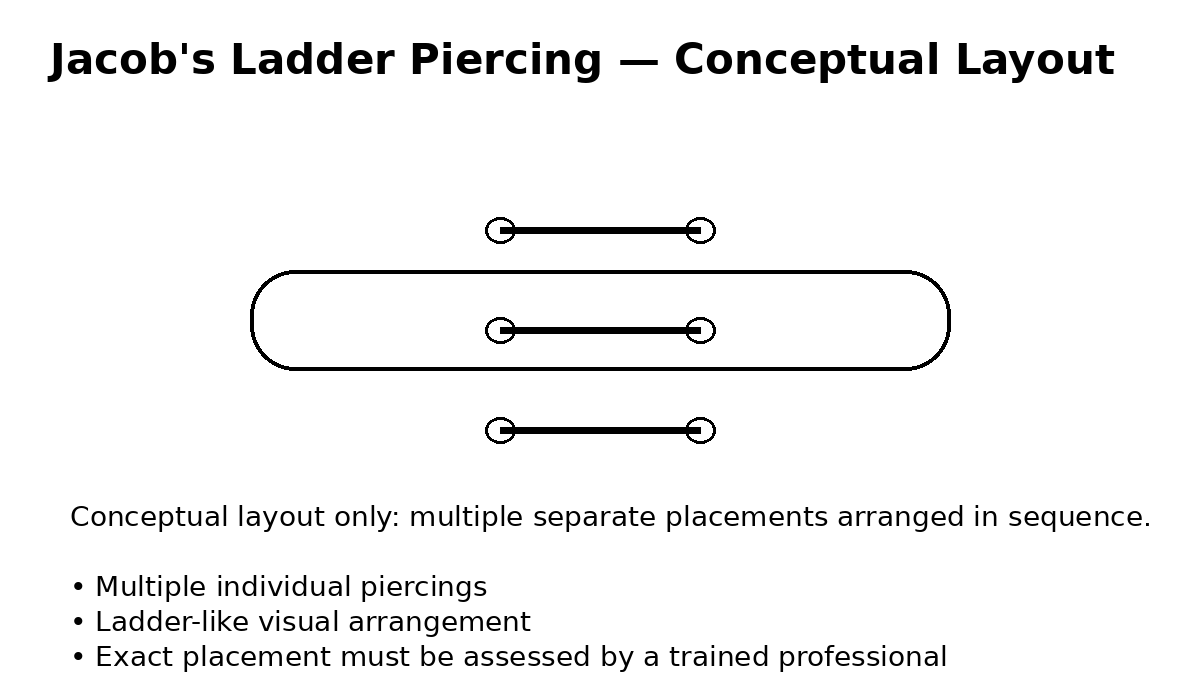
The illustration in this article is deliberately a simple educational diagram rather than an explicit anatomical photograph. It shows the basic idea: several separate placements arranged in sequence.
Actual placement depends on tissue thickness, available skin, previous piercings, scars, jewelry size and the piercer’s assessment. A professional may also recommend changing the number or spacing of placements if the requested design is not appropriate for the anatomy.
How Many Piercings Are Usually Involved?
There is no single required number. Jacob’s Ladder is better understood as a grouping or arrangement than as a fixed count.
Some people start with one or a few placements and decide later whether they want additional ones. This staged approach can make it easier to understand how the body reacts and can avoid creating a large number of fresh healing wounds at the same time.
A professional consultation should cover the desired final appearance, the number of placements, the spacing, the expected swelling and whether the proposed arrangement leaves enough healthy tissue between the openings.
Jacob’s Ladder vs. Other Male Genital Piercings
Jacob’s Ladder should not be confused with every other penile piercing. A Prince Albert, a frenum piercing, an apadravya and an ampallang involve different anatomical routes and therefore have different considerations.
A Jacob’s Ladder is commonly described as a sequence of frenum-style piercings. A frenum piercing is placed through tissue along the underside of the shaft. A Prince Albert uses a different route, while apadravya and ampallang involve the glans.
The terminology matters because jewelry, healing expectations and potential complications can differ substantially between placements.
What Happens During a Professional Consultation?
A responsible consultation should happen before the piercing begins. The piercer should discuss your goals, examine the relevant anatomy and explain whether the requested placement is realistic.
A professional should be comfortable saying no to a placement that is unsafe or unlikely to heal well. The Association of Professional Piercers recommends evaluating the piercer’s training, studio hygiene, sterilization equipment, jewelry quality and aftercare information before choosing a studio.
Does Jacob’s Ladder Piercing Hurt?
There is no universal pain score that accurately predicts the experience. Pain is influenced by individual sensitivity, anxiety, anatomy, the number of placements and the technique used.
The piercing itself is usually a brief event, but the healing period can involve tenderness, swelling or sensitivity. Multiple placements may also make the overall experience more demanding than a single piercing.
A better question than “How painful is it?” is “What should I realistically expect during and after the procedure?” Your piercer can explain the expected sensations for the specific placement they are recommending.
Healing Time
Healing is variable, and a piercing can feel comfortable before the internal tissue has completely matured. Piercings heal from the outside toward the inside, so the absence of pain does not automatically mean that the channel is fully healed.
The total healing burden can also increase when several fresh piercings are created. Friction, pressure, jewelry movement, poor hygiene, illness and repeated trauma may prolong healing.
Do not use a calendar alone to decide that a piercing is ready for unrestricted activity. The condition of the tissue and advice from an experienced professional matter more than a fixed number of days.
What Is Normal During Early Healing?
The Association of Professional Piercers notes that early healing can involve some localized bleeding, swelling, tenderness or bruising. Later, itching and a small amount of whitish-yellow secretion that forms crust can also occur.
The important distinction is the direction of change. Mild symptoms that gradually settle can be part of healing. Symptoms that become increasingly severe, especially when accompanied by heat, spreading redness, significant swelling, worsening pain, fever or concerning discharge, deserve professional or medical attention.
If something looks or feels significantly worse instead of gradually improving, do not assume that it is simply part of the healing process.
Jacob’s Ladder Aftercare
Good aftercare is simple but requires consistency. Wash your hands thoroughly before touching the area. During healing, use an appropriate sterile saline wound wash when recommended and avoid unnecessary manipulation.
The Association of Professional Piercers advises against rotating or spinning jewelry during cleaning. It also recommends avoiding harsh products such as alcohol and hydrogen peroxide because they can irritate healing tissue.
Over-cleaning is not better. Repeated rubbing, picking crusts and moving jewelry simply because it is there can keep a piercing irritated.
Sexual Activity During Healing
A healing genital piercing needs special care because sexual activity can introduce friction, pressure and exposure to bodily fluids.
Professional aftercare guidance emphasizes avoiding trauma and keeping the area hygienic during healing. If sexual activity is resumed before complete healing, it should not cause pulling, pressure or pain, and appropriate barrier protection should be considered to reduce exposure to bodily fluids.
Your piercer should give you placement-specific advice, and a healthcare professional should be consulted if you develop pain, bleeding, discharge or other concerning symptoms. When in doubt, giving the tissue more time is safer than repeatedly irritating it.
Exercise and Daily Activities
Exercise may be possible during healing, but activities that repeatedly rub, compress or jostle the piercing should be modified. Clean clothing and good hygiene are particularly important.
If a specific activity causes throbbing, pulling, bleeding or repeated irritation, stop and discuss the issue with your piercer. Healing is not improved by trying to “push through” mechanical irritation.
Swimming and Water Exposure
Pools, hot tubs, lakes and other bodies of water can expose a fresh piercing to microorganisms and chemicals. The Association of Professional Piercers recommends avoiding submerging healing piercings in such water.
A normal shower is generally easier to manage than soaking. If water exposure is unavoidable, ask your professional piercer about appropriate protection for the particular placement.
Jewelry Choices
Jewelry should be selected for the individual piercing rather than chosen only for appearance. A professional considers the tissue, swelling, placement and required length or diameter.
Common jewelry formats for frenum-style placements can include straight barbells, but the exact choice should be made by an experienced piercer. The initial piece needs enough room for expected swelling without being excessively long and prone to catching.
Quality and construction matter as well. The Association of Professional Piercers recommends appropriate body-jewelry materials and well-finished jewelry, and its studio checklist highlights internally threaded or threadless jewelry as a quality consideration.
Jewelry Material
Ask the studio to identify the actual jewelry material rather than accepting a vague label such as “surgical metal.”
For a fresh piercing, material quality and surface finish are important. Poor-quality jewelry can contribute to irritation or metal sensitivity. A professional should be able to explain what material is being used and why it is appropriate for the placement.
Do not change healing jewelry yourself unless a qualified professional has advised you to do so. Some piercings need a professional downsize after initial swelling decreases.
How to Choose a Piercer
For an intimate piercing, professional experience should carry more weight than price alone.
The Association of Professional Piercers recommends checking whether a studio has an autoclave, appropriate sterilization practices, suitable jewelry and current aftercare guidance.
Questions to Ask Before Booking
Ask these questions before paying a deposit:
Clear answers are a good part of informed consent. If a piercer dismisses reasonable safety questions or pressures you to proceed, reconsider the appointment.
Potential Risks
A Jacob’s Ladder has the usual risks of a body piercing plus risks associated with the location and the possibility of multiple piercing channels.
Potential problems include infection, prolonged irritation, bleeding, migration, rejection, scarring, jewelry catching and tissue injury. Incorrect placement or poor jewelry fit can increase mechanical stress.
Because genital tissue contains nerves and blood vessels, complications can sometimes have consequences beyond appearance. Persistent changes in sensation, significant pain, difficulty urinating, unusual bleeding or changes in sexual function should be evaluated medically.
No reputable professional should promise that complications are impossible.
Infection Warning Signs
Seek medical advice if you develop symptoms such as increasing pain, significant swelling, spreading redness, unusual warmth, pus-like discharge, fever or feeling generally unwell.
Do not rely on an online article to diagnose an infection. The Association of Professional Piercers also advises seeking medical attention when infection is suspected.
If infection is suspected, do not automatically remove the jewelry yourself. Closing the surface can sometimes interfere with drainage. Discuss the situation with a healthcare professional and your piercer.
Migration and Rejection
Migration means the jewelry gradually moves from its original position. Rejection refers to the body progressively pushing the jewelry toward the surface.
Warning signs can include increasingly thin tissue around the jewelry, a noticeable change in angle, increasing visibility of the bar or persistent irritation.
If you notice these changes, have the piercing assessed promptly. Continuing to apply pressure or repeatedly catching the jewelry can make the problem worse.
Bleeding
A small amount of bleeding can occur with a fresh piercing, but persistent or heavy bleeding is not something to ignore.
Avoid activities that repeatedly reopen the area. If bleeding is substantial, does not settle with appropriate first-aid measures, or is accompanied by dizziness or other concerning symptoms, seek urgent medical care.
Scarring
Any piercing can leave a mark after the jewelry is removed. The final appearance varies between people and can be affected by irritation, migration, infection, individual scar formation and the number of piercing channels.
Do not assume that removing jewelry guarantees invisible skin. A professional can explain the likely outcome for your anatomy, but nobody can predict the exact final scar.
Can It Affect Sensation or Sexual Function?
A genital piercing can affect sensation if complications occur. The concern is not that every Jacob’s Ladder piercing causes sexual problems; rather, injury, infection, scarring or nerve involvement can create unwanted changes.
If you notice persistent numbness, severe pain, unusual loss of sensation, erectile changes or another significant functional change after piercing, seek medical assessment. These symptoms should not simply be treated as normal healing.
Can the Piercing Be Removed?
Yes, jewelry can generally be removed if the owner decides not to keep the piercing. However, healing tissue needs special consideration.
If the piercing is healthy and you simply no longer want it, a professional can help with removal and aftercare while the channel closes. If infection is suspected, consult a healthcare professional before removing jewelry.
Even after removal, a small scar or visible mark may remain.
Cost
There is no universal price for a Jacob’s Ladder because the cost depends on the studio, location, number of placements, jewelry material and the piercer’s experience.
When comparing prices, ask whether the quoted amount includes quality initial jewelry, sterile supplies, the consultation and follow-up care. A very low price should not outweigh concerns about hygiene, experience or jewelry quality.
For an intimate piercing, paying for appropriate professional standards is more important than choosing the cheapest available option.
Common Mistakes to Avoid
Avoid these common mistakes:
Simple Aftercare Checklist
Frequently Asked Questions
Is Jacob’s Ladder one piercing?
No. The term usually describes a group of individual piercings arranged in a ladder-like sequence.
Is there a fixed number of piercings?
No. The number varies with anatomy, preference and professional assessment.
Is it the same as a Prince Albert?
No. They are different genital piercing placements with different anatomical routes.
Is it painful?
Pain varies between individuals and depends on placement, sensitivity and the number of piercings.
How long does it take to heal?
Healing varies. Feeling comfortable does not necessarily mean the internal tissue has completely healed.
Can I rotate the jewelry while cleaning?
No. The Association of Professional Piercers advises that rotating jewelry is unnecessary and can irritate healing tissue.
Can I use alcohol or hydrogen peroxide?
These harsh products are not recommended for routine piercing aftercare because they can damage or irritate healing cells.
Can I swim after getting it?
It is better to avoid submerging a healing piercing in pools, hot tubs, lakes and similar water.
Can I change the jewelry myself?
Avoid changing healing jewelry yourself. Ask a qualified piercer about any necessary size adjustment or jewelry change.
What if it becomes infected?
Seek medical advice. Do not rely solely on home remedies, and do not automatically remove jewelry without professional guidance.
Can it leave a scar?
Yes. Any piercing can leave a permanent mark after removal.
Is Jacob’s Ladder suitable for everyone?
No. Anatomy and individual circumstances differ. A qualified piercer should assess the proposed placement before proceeding.
Final Takeaway
Jacob’s Ladder piercing is best understood as a customizable group of genital piercings rather than a single standardized procedure. The defining feature is the ladder-like arrangement of separate placements.
If you are researching one, the most important decisions happen before the needle is used: choose an experienced professional, have your anatomy assessed, ask about sterilization and jewelry, understand the risks, and get clear written aftercare.
During healing, gentle care and minimizing friction are more useful than complicated routines. Do not assume that more cleaning, more movement or faster jewelry changes will make the piercing heal faster.
Finally, pay attention to changes that are outside normal healing. Worsening pain, significant swelling, spreading redness, fever, unusual discharge, persistent bleeding or changes in sensation or function deserve professional or medical assessment.
This article is educational and does not replace an in-person consultation with a qualified piercer or medical professional.
Leave a Reply