

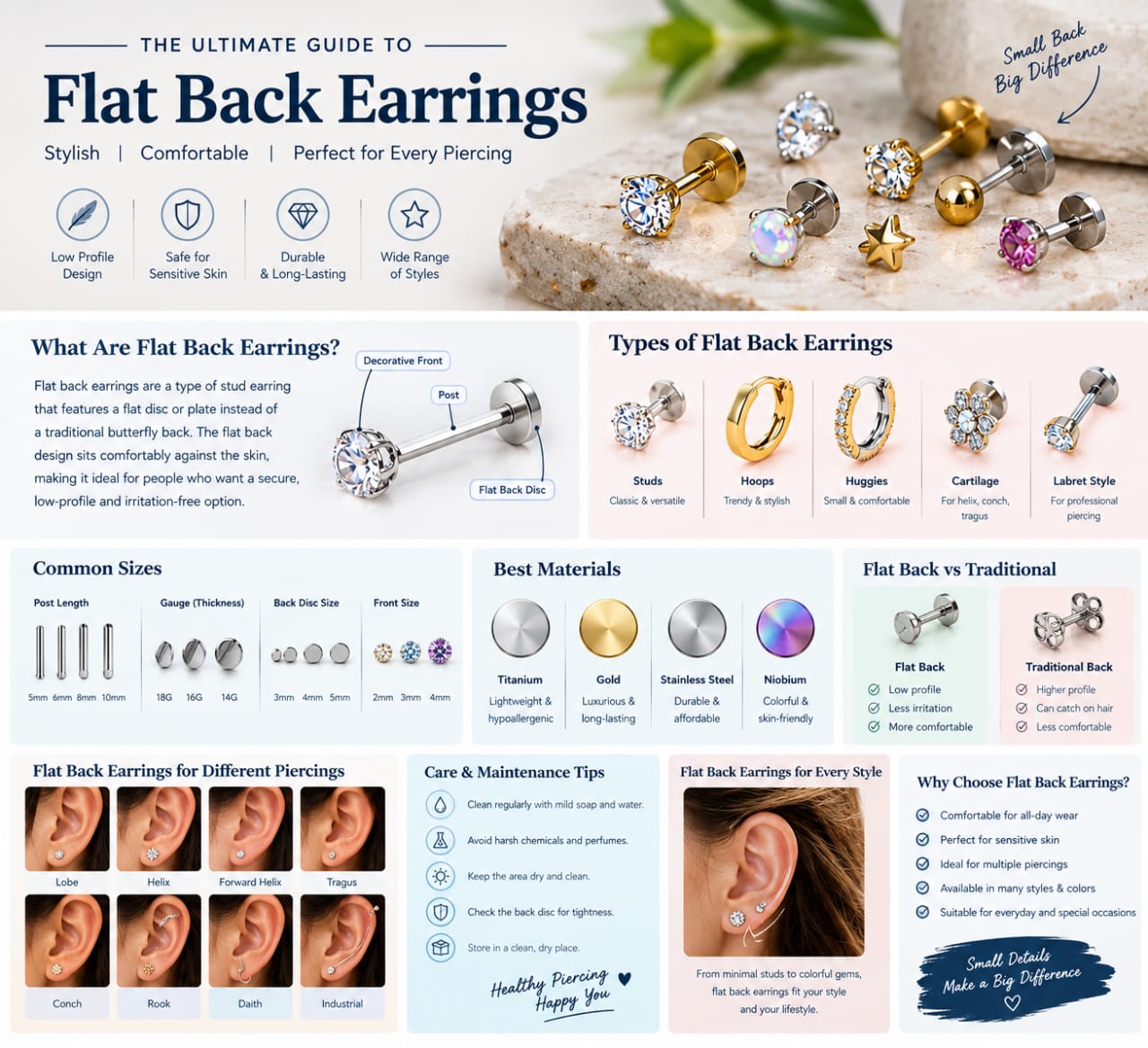

Learn everything about flat back earrings, including sizing, materials, piercing compatibility, comfort, aftercare, styles, buying tips, and common mistakes.

A flat back earring is a type of stud earring designed with a smooth, low-profile disc or plate behind the ear instead of the traditional butterfly clutch. The simple shape can make the jewelry feel less bulky, especially when the back of the ear touches a pillow, headphones, a helmet, hair, or clothing. Flat back earrings are also popular for curated ear styling because their clean profile works well with many piercing placements.
The term “flat back earring” describes the construction rather than one particular gemstone, metal, or fashion style. A flat-back piece can have a plain ball, gemstone, bezel, flower, star, hoop-inspired front, or another decorative end. The post and back can also use different attachment systems, including internally threaded and threadless designs.
This guide explains what flat back earrings are, how they fit, how to choose materials and sizes, where they are commonly worn, how to care for them, and what to consider before buying.
What Is a Flat Back Earring?
A flat back earring is jewelry made with a decorative front connected to a post and a flat disc-shaped backing. When the earring is worn, the disc rests against the back of the ear. Because the backing is relatively flat, it has a lower profile than many traditional butterfly-style backs.
This construction is especially useful when the wearer wants a neat appearance from both sides of the ear. Comfort still depends on correct sizing, anatomy, jewelry quality, and the condition of the piercing.
Flat back earrings are available in many finishes, including minimalist beads, gemstones, geometric shapes, flowers, stars, and precious-metal details.
Why Are Flat Back Earrings Popular?
The main appeal of flat back earrings is their low-profile design. A traditional butterfly clutch can have edges that are noticeable when the ear presses against a pillow. A flat disc can feel more streamlined.
Another advantage is styling flexibility. A small flat-back stud can be worn alone in a lobe piercing, while several small pieces can be combined across multiple ear piercings. Comfort is a major reason people choose them, but a flat back is not automatically comfortable for everyone. A post that is too short can create pressure, while one that is too long can move excessively and catch on hair.
Flat Back Earring vs Butterfly Back
Both designs can hold a stud securely, but their construction is different. A butterfly back generally uses a small metal clutch that slides onto a post. A flat-back design uses a flat disc and may use a threaded or threadless connection.
For everyday wear, many people prefer the low-profile feel of a flat back. Traditional butterfly backs remain common because they are familiar, inexpensive, and easy to find. Neither design is automatically superior in every situation; the best choice depends on fit, material, piercing location, and personal comfort.
Understanding Flat Back Earring Size
The most important measurements are usually post length, post thickness or gauge, decorative front size, and back-disc diameter.
Post length determines how much room the jewelry has inside the piercing. A newly pierced or recently irritated area may require different room than a fully healed piercing. Jewelry should not be so tight that it creates constant pressure.
The front size affects appearance and weight. Tiny ends are subtle, while larger fronts make a stronger visual statement. Heavy decorative pieces can pull on the piercing.
Back-disc size affects the contact area behind the ear. A larger disc may distribute pressure over a wider area, but it can also feel more noticeable.
Choosing the Right Post Length
Do not choose post length only by copying a number from another person's ear. Ear thickness varies, and different piercing locations have different requirements.
For a healed piercing, the ideal post generally provides enough room for normal movement without leaving excessive empty space. If the jewelry feels tight, leaves a persistent indentation, or appears to press into tissue, the fit may be too short. If it swings significantly or catches frequently, it may be too long.
For a new or healing piercing, professional assessment is particularly useful because swelling can change the required length.
Gauge and Post Thickness
Gauge refers to the thickness of the post. Jewelry standards vary by manufacturer and piercing type, so check the seller's measurement system carefully.
The post should be compatible with the existing piercing. Forcing jewelry that is too thick can injure tissue, while a poorly fitting thin post may not provide the desired feel or stability. If you are unsure about gauge, especially for a healing piercing, ask a reputable professional rather than forcing the jewelry.
Flat Back Earrings for Different Piercings
Flat backs are commonly used in lobe piercings and are also popular for several cartilage placements. The ideal shape and length depend on anatomy and the exact location.
For a standard lobe, a small decorative end with a comfortable post can be a versatile everyday choice. For helix and forward-helix placements, the low-profile backing can help reduce contact with hair or bedding.
Tragus and conch jewelry require careful sizing because these areas have different tissue thicknesses and can interact with headphones or other accessories. Industrial-style placements are more specialized and should be fitted based on anatomy rather than generic size charts.
Materials: Titanium, Gold, Niobium and More
Material quality matters because jewelry remains in prolonged contact with skin and sometimes healing tissue.
Implant-grade titanium is widely favored for piercing jewelry because it is lightweight and commonly chosen when minimizing exposure to nickel is important. Verify the exact grade rather than assuming every product labeled “titanium” meets the same standard.
Gold can be an excellent jewelry material when appropriately manufactured and suitable for piercing use. Solid gold and quality construction are different from inexpensive plated items whose surface can wear over time.
Niobium is another material used for body jewelry. Stainless or surgical steel products vary by composition and individual tolerance, so vague marketing terms should not be treated as a guarantee of suitability.
Threaded vs Threadless Flat Backs
Threaded flat backs connect the decorative end and post using matching threads. Threadless jewelry uses a press-fit connection in which the end is held by tension inside the post.
Threadless designs can be convenient for small decorative ends and allow different fronts to be changed without replacing the entire post. Threaded designs can also be secure and are familiar to many jewelry users.
Do not mix parts from unrelated systems unless the manufacturer or a professional confirms compatibility.
Flat Back Earrings and New Piercings
Jewelry for a new piercing needs more consideration than jewelry for a fully healed piercing. Swelling, tenderness, crusting, and changes in tissue size can occur during healing.
A flat back can be useful because its profile may reduce accidental snagging, but the backing still has to allow appropriate room. Do not repeatedly remove or rotate healing jewelry just to inspect the piercing.
Seek professional advice if there is significant swelling, worsening pain, spreading redness, unusual discharge, fever, or jewelry becoming embedded.
Cleaning and Aftercare
For a healing piercing, gentle care is usually preferable to aggressive cleaning. Wash your hands before touching the area, follow the aftercare routine recommended by your professional, and avoid unnecessary manipulation.
Harsh chemicals, repeated twisting, picking at crusts, and frequent jewelry changes can irritate tissue. Hair products and cosmetics can also collect around a piercing.
A healed piercing still benefits from ordinary hygiene. Clean the area gently rather than scraping or pulling at the skin.
Sleeping With Flat Back Earrings
One reason people like flat-back jewelry is the reduced profile behind the ear. However, sleeping comfort still depends on the piercing location and how the ear contacts the pillow.
If a piercing is healing, direct pressure can prolong irritation. A clean pillowcase and a sleeping position that avoids pressing on the piercing may help.
Do not assume a flat back makes sleeping on a fresh cartilage piercing harmless.
Headphones, Hair and Everyday Activities
Headphones, helmets, masks, glasses, hair, and clothing can all contact ear jewelry. A low-profile backing may reduce interference, but the front and post still need to be positioned correctly.
Over-ear headphones can press on cartilage piercings. Hair can wrap around jewelry and pull unexpectedly. If an activity repeatedly causes pressure or snagging, changing the accessory, hairstyle, or jewelry style may help.
How to Choose Flat Back Earrings for Sensitive Ears
For sensitive ears, material transparency is more important than marketing language. Look for clear information about the metal or material, manufacturing quality, and intended use.
Avoid assuming that a cheap “hypoallergenic” label is enough to prove suitability. If you know you react to a particular metal, choose a material you have previously tolerated or consult a qualified professional.
A smooth finish also matters. Rough surfaces, sharp edges, or poorly polished posts can create mechanical irritation.
Flat Back Earring Styles
Flat-back earrings are available in many styles. Tiny round studs are popular for minimalist looks. Gemstone ends can add sparkle without requiring a large piece of jewelry. Gold-colored or solid-gold designs can create a classic appearance.
Geometric shapes, flowers, stars, hearts, initials, and small symbols can be combined in a curated ear. For daily wear, lightweight designs are often easier to manage.
Flat Back Earrings for Men, Women and Teens
Flat-back jewelry is not limited to one gender. The same construction can suit anyone who likes a low-profile stud.
For men, simple titanium, steel, or gold-tone studs can create a clean everyday look. Women may choose anything from tiny minimalist ends to gemstones and mixed-metal styling. Teens should use age-appropriate jewelry and follow relevant guidance from a parent or guardian.
The best choice is based on personal style, anatomy, comfort, and jewelry quality rather than gender labels.
Price and Value
Flat-back earrings can range from inexpensive fashion pieces to high-end jewelry. Price is influenced by material, gemstone, manufacturing quality, brand, finishing, and attachment system.
A low price does not automatically mean a bad product, but extremely vague descriptions should make buyers cautious. A high price does not automatically guarantee a perfect fit or appropriate material.

Compare material, post size, back dimensions, closure type, return policy, and seller information.
Common Buying Mistakes
One common mistake is buying based only on the front design. A beautiful earring can still be uncomfortable if the post is too short or the material is unsuitable.
Another mistake is assuming every flat back uses the same attachment system. Threaded and threadless components are not automatically interchangeable.
Buyers should also check measurements carefully. Product photos can make jewelry look larger or smaller than it really is. Persistent pain, increasing swelling, or jewelry pressing into tissue should not be ignored.
How to Put In and Remove a Flat Back Earring
Wash and dry your hands before handling jewelry. Work in a clean, well-lit area so small components do not fall onto an unclean surface.
The exact removal method depends on the jewelry system. Threaded ends generally unscrew, while threadless ends are removed according to the manufacturer's press-fit design. Do not force a connection if it will not move.
If a healing piercing is involved, avoid unnecessary removal. If jewelry appears stuck, embedded, or painful to remove, seek professional assessment.
Problems: Redness, Swelling, Bumps and Embedding
Mild irritation can happen after friction, pressure, accidental pulling, or a jewelry change. Persistent or worsening symptoms should not be dismissed.
A bump can have several possible causes, including mechanical irritation and other skin responses. Squeezing or popping a bump is not a good general solution.
If the ear becomes increasingly swollen, hot, very painful, develops spreading redness or unusual discharge, or the jewelry begins disappearing into the tissue, seek appropriate professional or medical advice promptly.
Buying Flat Back Earrings Online
Online shopping is convenient, but measurements and material descriptions deserve careful attention. Look for a clear product specification rather than relying only on photographs.
Useful information includes the metal or material, post length, post thickness, front dimensions, backing dimensions, closure type, and care instructions. Reviews can reveal practical information about fit and finish, but individual anatomy differs.
Flat Back Earrings and a Curated Ear
A curated ear is a deliberate combination of multiple earrings and piercing placements. Flat backs are useful because the rear profile remains visually discreet.
A balanced arrangement can combine tiny studs, gemstones, different shapes, and varied sizes. One approach is to establish a focal piece and use smaller pieces around it. Another is to repeat a material across several placements.
Do not add jewelry to an unhealed piercing simply to complete a visual layout. Healing and fit should come first.
Frequently Asked Questions
1. What is a flat back earring? A flat back earring has a decorative front, a post, and a flat disc-style backing.
2. Are flat back earrings comfortable? They can be, especially when correctly sized and made from suitable material, but comfort varies.
3. Are flat backs better than butterfly backs? Neither is universally better. Flat backs are often preferred for a low-profile feel.
4. Can I sleep in flat back earrings? Many people do with healed piercings, but pressure can still cause discomfort.
5. Are flat backs good for helix piercings? They are commonly used for helix jewelry when the post length and material are appropriate.
6. What metal is best for sensitive ears? Clearly specified, high-quality materials such as appropriate implant-grade titanium are commonly considered good options, but individual sensitivities vary.
7. What is threadless jewelry? It uses a press-fit connection between the decorative end and post.
8. What is an internally threaded flat back? The decorative end screws into the post using an internal threaded connection.

9. Can I change a flat back myself? For a fully healed piercing, careful changes may be possible, but unfamiliar systems can be difficult.
10. Why does my flat back feel tight? The post may be too short, swelling may be present, or the tissue may be irritated.
11. Why does my flat back keep moving? The post may be too long, the fit may be unsuitable, or the jewelry may be getting pulled.
12. Can flat backs be worn in lobe piercings? Yes, they are a common choice.
13. Can flat backs be used in tragus piercings? They can be, but the fit must account for anatomy and nearby accessories.
14. Are gold flat backs safe? Suitable solid gold jewelry can be appropriate, but quality and alloy composition matter.
15. Are titanium flat backs good for everyday wear? High-quality titanium jewelry is popular for everyday use because it is lightweight and commonly well tolerated.
16. How do I clean a flat back earring? Use the gentle cleaning method recommended for your piercing and avoid harsh chemicals.
17. What should I do if my flat back is embedded? Do not force it out. Seek prompt professional or medical assessment.
18. Can I wear flat backs in multiple piercings? Yes, once each piercing is ready and correctly fitted.
19. How do I know the right post length? A professional piercer can measure the piercing and account for swelling and anatomy.
20. Are flat back earrings only for women? No. They are a unisex jewelry construction.
Semantic SEO Topic Cluster for Flat Back Earring
Useful supporting topics include flat back stud earrings, flat back earrings for cartilage, helix flat back earrings, tragus flat back earrings, conch jewelry, threadless flat backs, internally threaded jewelry, titanium flat backs, gold flat backs, earrings for sensitive ears, earring post length, earring gauge, flat-back sizing, earring aftercare, sleeping with cartilage jewelry, minimalist earrings, gemstone studs, curated ear jewelry, and everyday piercing jewelry.
These related concepts help a reader understand the subject from several angles and create opportunities for internal links to more specific guides on piercing locations, jewelry materials, aftercare, sizing, and styling. The primary keyword should remain natural and should never be inserted into every heading simply to increase keyword density.
Conclusion
Flat back earrings combine a simple construction with practical styling flexibility. Their low-profile backing can be comfortable for many wearers, particularly when the jewelry is correctly sized and the piercing is suited to the design.
The most important buying factors are not just appearance and price. Check the material, post length, thickness, front size, backing dimensions, attachment system, and seller information. For new or irritated piercings, professional fitting and appropriate aftercare are more important than changing jewelry for fashion.
Whether you prefer a tiny titanium stud, a gold gemstone end, or a coordinated curated ear, a well-made flat back earring can be a useful addition to an everyday jewelry collection. Choose based on fit and quality first, then let the style follow.
Quick Comparison Table
Feature | Flat Back | Butterfly Back |
Back profile | Low-profile flat disc | Raised clutch |
Common attachment | Threaded or threadless | Push-on clutch |
Typical appeal | Comfort and discreet profile | Simple and widely available |
Sizing importance | High | Moderate to high |
Styles | Many decorative fronts | Many standard studs |
Leave a Reply