


What Is a Conch Piercing?
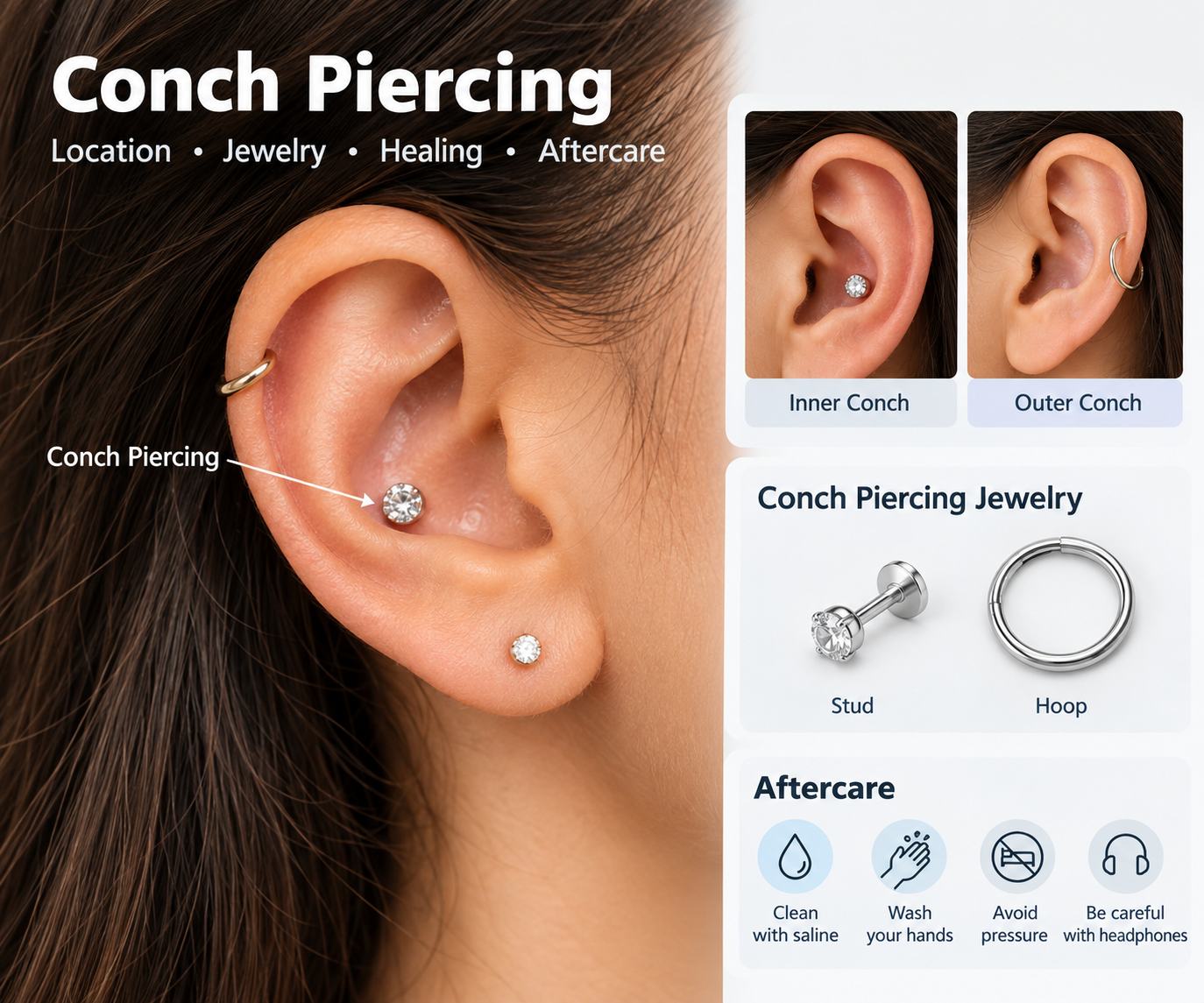
A conch piercing is a cartilage piercing placed through the central portion of the outer ear. The name comes from the ear’s resemblance to a conch shell.
Two common placements are the inner conch, located in the deeper bowl-shaped area, and the outer conch, positioned farther toward the outer cartilage. The exact placement should be chosen according to your ear anatomy and the look you want. A professional piercer should assess your ear before piercing it.

Inner vs. Outer Conch Piercing
An inner conch sits in the deeper central bowl of the ear and is often paired with a flat-back labret or small decorative stud. An outer conch sits closer to the outer cartilage and can create a different relationship with helix or other ear piercings.
Neither placement is universally better. Anatomy, jewelry choice, and the desired result all matter.
How Painful Is a Conch Piercing?
A conch piercing generally feels more intense than a standard earlobe piercing because it passes through cartilage. People may notice a brief sharp pinch, pressure, short-term throbbing, or tenderness afterward.
Pain varies from person to person and can depend on pain tolerance, anatomy, the piercer’s technique, stress, jewelry, and aftercare. The piercing itself is usually very quick.
How Long Does a Conch Piercing Take to Heal?
Cartilage piercings commonly take several months to heal, and some conch piercings may take longer. A piercing can feel comfortable on the outside while deeper tissue is still healing.
Do not assume it is fully healed simply because it looks normal. Avoid unnecessary touching, twisting, pressure, and early jewelry changes.
Conch Piercing Aftercare
1. Wash your hands before touching the piercing.
2. Clean gently with sterile saline wound wash as recommended by your piercer.
3. Do not twist or rotate the jewelry.
4. Avoid sleeping directly on the piercing.
5. Keep headphones, helmets, hats, hair, and other sources of friction from repeatedly pressing or catching the area.
6. Keep hair products and cosmetics away from the healing piercing.
7. Follow your professional piercer’s written aftercare instructions.
What Jewelry Is Best for a Conch Piercing?
A flat-back labret is a common choice for a fresh conch piercing because it can provide a stable fit. Implant-grade titanium is widely used for fresh body piercings because it is lightweight and suitable for many people.
There is no universal jewelry size. Post length, gauge, and diameter should be selected according to your anatomy, placement, expected swelling, jewelry style, and healing progress.
Studs vs. Hoops
Studs are often easier to keep stable during initial healing. Hoops can look excellent in a healed conch, but they move more and may create additional pressure or friction.
Do not switch to a hoop simply because you prefer the appearance. Ask your piercer whether the piercing has healed enough for the change.
Can You Sleep on a Conch Piercing?
Avoid direct pressure on a fresh conch piercing. Sleeping on it can contribute to soreness, swelling, irritation, jewelry pressure, and delayed healing.
If you sleep on your side, try the opposite side or use a pillow arrangement that leaves space around the ear.
Can You Wear Headphones With a Conch Piercing?
Headphones and earbuds may need to be adjusted during healing. Over-ear headphones can press against the ear, while earbuds may contact the piercing depending on its exact placement.
If a device repeatedly touches, rubs, or compresses the piercing, give the area more space while it heals.
Conch Piercing Bump: Why Does It Happen?
A small bump is not automatically an infection. Irritation can result from pressure, friction, sleeping on the piercing, frequent touching, hair catching on jewelry, headphones, changing jewelry too early, or over-cleaning.
If a bump continues to enlarge, becomes increasingly painful, or is accompanied by concerning discharge or spreading redness, seek professional medical advice.
How Do You Know if a Conch Piercing Is Infected?
Mild redness, swelling, tenderness, and sensitivity can occur during normal healing. Seek medical attention if you develop increasing pain, significant swelling, unusual heat, spreading redness, pus-like discharge, fever, chills, red streaking, or feel generally unwell.
Cartilage infections can become serious. Do not remove jewelry on your own to treat a suspected infection unless a healthcare professional advises you to do so.
How Much Does a Conch Piercing Cost?
Prices vary by location, studio, piercer experience, sterilization standards, and jewelry material and design. When comparing studios, consider the complete service rather than choosing based only on the lowest price.
When Can You Change Conch Jewelry?
There is no single date that applies to everyone. A professional piercer should assess whether the piercing is sufficiently healed before a jewelry change.
Signs that it may be ready include no persistent swelling, no ongoing tenderness, no abnormal discharge, comfortable jewelry movement, and confirmation from a professional.
Does a Conch Piercing Close?
Yes. Like other piercings, a conch piercing can shrink or close after jewelry is removed. How quickly this happens varies by person and depends on factors such as how established the piercing is.
If you want to remove it permanently, ask a professional piercer or healthcare professional about appropriate care.
Conch Piercing vs. Helix Piercing
Both are cartilage piercings, but their locations differ. A conch is placed in the central ear cartilage, while a helix is placed along the outer upper ear rim. Both can take several months to heal, and both can be irritated by sleeping pressure or friction.
Tips for a Successful Conch Piercing
• Choose an experienced professional piercer.
• Confirm that sterile, single-use equipment and appropriate hygiene practices are used.
• Choose quality body jewelry.
• Follow the aftercare instructions you receive.
• Avoid unnecessary touching and pressure.
• Be patient before changing jewelry.
• Seek professional medical advice if healing becomes increasingly painful, swollen, hot, or otherwise concerning.
Frequently Asked Questions
Is a conch piercing painful? — It can be more uncomfortable than an earlobe piercing because it passes through cartilage, but pain varies.
How long does it take to heal? — Several months is common, and some piercings take longer.
Can I put a hoop in a new conch piercing? — Your piercer should determine what jewelry is appropriate during initial healing; hoops are often better suited to healed piercings.
Can I sleep on it? — Avoid direct pressure while it is healing.
Is a conch piercing safe? — It is a common cartilage piercing, but all piercings carry risks such as irritation, allergic reactions, scarring, and infection.
Which is better, inner or outer conch? — Neither is universally better; the appropriate placement depends on anatomy and the desired appearance.
Final Thoughts
A conch piercing can be a versatile addition to an ear-curation setup, from a subtle stud to a statement hoop after healing. The key factors are professional placement, suitable jewelry, gentle aftercare, reduced pressure and friction, and patience during healing.
If you notice persistent or worsening symptoms such as spreading redness, severe pain, significant swelling, pus-like discharge, or fever, seek medical care rather than trying to manage a possible infection yourself.
Leave a Reply